“Chapter 3. Education” in “The University in Transition”
Education
Education for society
Society is changing, which calls for Open Science and a changing university. From ‘ivory tower’ to participation in, and interaction with, both the local and global environment. This has implications for research, as we explained in detail in the previous chapter, but just as well for education. Education is the activity through which we possibly have the greatest impact on society. We often talk about the societal relevance and impact of research, but without education, there would be no university. And through its educational role university has a major impact on society in several ways.
The main impact of education is, of course, on and through students. To begin with, education has a direct civil effect for the student: a degree gives access to qualified positions and empowers them professionally (qualification and socialisation). In addition, and just as importantly, education has a major impact on a person’s self and who one wants to be in society (subjectification)[1]. This means that education influences both what one’s skills are and how these can be used, but also how one wants to utilize those skills in society. In short, a university education affects a person’s relationship with society. Education therefore not only has an immediate impact via a degree, but also a lasting influence on the rest of one’s life, and therefore on the impact a person will have in society.
In addition, education also affects teachers and others involved in providing the education. Through the design, delivery and assessment of education, a teacher relates to one’s discipline: its knowledge and epistemology, its current practices and research. The best way to reflect on your expert knowledge is to think about how to educate students in it. This effect is further enhanced by questions and interactions with students or colleagues and others in the educational team. Designing, implementing, and testing education forces you to reflect on the essence of what you want to convey. This, in turn, leads to reflection on your expertise and your field in relation to society, and to reflection upon your own person and position. So, a role in education does not just equal a neutral transmission of knowledge. To begin with, we can only create the conditions under which learning can take place; the learning is done by the student. But education is not neutral in content and form, either. The choices teachers make forces them to relate to what they teach and how it is taught, both individually and as a team. Finally, education can also have concrete, immediate benefits. This may not apply to all educational activities, but it does apply to education with practical components and (co-)creation or production as part of the learning process. Some examples include an academic or societal internship, a project in a neighbourhood or city, or a design assignment in collaboration with societal stakeholders. The learning outcome should always come first in such activities, of course, but the societal outcome can also be part of it. Concrete projects, including those for external stakeholders, can be highly motivating and instructive, and the returns can be seen as a direct contribution of education to society.
In short, it is important to realise that education impacts society in a multitude of ways. And that the effects of educating students continue long after graduation. It is therefore important to consider explicitly what purpose our education serves. What the effect of education may be on those who participate in it. After all, through education, the university has a long-term and fundamental influence on the society of the future.
The education of the future?
What purposes do we want to educate for? As we explained in the chapter on Open Science, universities have a responsibility to address societal challenges through education and research. We strive to prepare our students to contribute to society, the environment, health, and well-being, and to ecological, economic and social sustainability. The complexity and interconnectedness of major societal issues calls for collaboration both in research and in higher education: inter- and transdisciplinary[2], inter-institutional, and trans-national. Digitisation, and in particular Artificial Intelligence (AI), is going to have a major impact on everything we do and raises many issues, not in the least ethical and social ones; see Inset 3.1.
Inset 3.1. Artificial Intelligence (AI) in education and research.[3]
The field of AI has developed rapidly in recent decades, especially in the area of learning systems (machine learning). Some early highlights of this development include generative AI systems like ChatGPT. AI has also found broad applications: almost all scientific fields use AI in research, from predicting protein structures in biochemistry, to tracing a pseudonym to a book’s real author.
The emergence of ChatGPT has led to many developments in education as well. Generative AI can assist with writing essays and the production of educational materials. Learning AI systems can also help staff spot patterns, such as dropout risks. But there are drawbacks and challenges to each of these applications; the tools should not be used for purposes beyond decision support, and the tools need to know what bias (prejudices) they were trained with, and what ecological footprint their training has left. Research is being conducted at many levels to learn how science education and research can use AI responsibly and inclusively, without disadvantaging specific groups.
The rapid development of AI in education and research, as well as in society, demands new competencies from both students and staff, in terms of knowledge and understanding of the underlying technology and the ethical aspects of its use.
Open Science requires thinkers with a broad outlook and an open attitude. It requires students who can think independently and critically from a disciplinary or multidisciplinary foundation, while being open and equipped to cooperate between and across disciplines. And thus are able to collaborate both within and outside the own discipline, as well as with societal partners and other stakeholders. This way they may contribute to collective knowledge and progress, and to a sustainable and inclusive society. Importantly they must also be aware of the importance of constant development, and develop the necessary skills to that end. A famous quote by Malcolm Forbes is apt here: ‘Education’s purpose is to replace an empty mind with an open one’. In the vision we outline here in this book, such an open mind not only entails being open to one’s own development, but also to other perspectives and cooperation: to Open Science.
To foster such an open perspective, curricula should provide students with opportunities for reflection and contemplation, encourage initiative, and allow fallible projects. Making mistakes, where this is without endangering oneself or others, is not penalized and is seen as part of the process. However, learning from your mistakes is imperative. Curricula should provide room for individual choices, and encourage and reward personal leadership and initiative. After all, we are educating the formal and informal leaders of the future: intellectual thinkers who can reflect and act on the constant changes in society and the major challenges it faces. And to optimally fulfil our role in society, universities should not only prepare students for lifelong learning, but also provide continuous education in order to do so. That way the university can stand in a continuous knowledge relationship with society.
Not only society is constantly changing. Being part of that society, individual students as well as the student population at large are also constantly changing. New generations grow up in different circumstances and contexts than the generations that teach them. This is something to be constantly aware of and which requires close collaboration with students in the designing and delivering of education. Students not as passive recipients, but rather as active agents in a lively learning- and academic community. The recent COVID-19 pandemic has clearly illustrated how we are all connected globally, and how fast developments can occur. The pandemic also taught us to reinvent how we interact. An entire generation was forced to maintain social distance during a crucial two years of their lives. The consequences will continue to reveal themselves in the coming years, but it is already clear that major changes are taking place. COVID-19 may have been exceptional in its extent, but it illustrates a process of change that will not stop anytime soon. It is therefore crucial for the university to remain constantly in tune with society and its needs for knowledge and education. That will require adaptability and innovation in our curricula, in close cooperation with students and societal stakeholders regarding both its design and implementation.
The aspiration of Open Science thus requires fundamental adjustments to education and the education system as a whole. We will elaborate on this vision below, starting by briefly looking back at history. We already touched on history of universities in Chapter 1, but in the current chapter we focus specifically on the most important developments for education. We will then continue with making a case for change, followed by elaborating our vision on education based on five principles: OPENNESS, TRANSFORMATION, EMPOWERMENT, FLEXIBILITY, and COLLABORATION. These principles pertain to content, form, and organisation of education. We conclude the chapter with several preconditions for making this vision possible.
Looking back in time
Although knowledge institutions existed before the Middle Ages, including in Asia and Africa, the contour of today’s universities finds its origins in medieval Europe. Chapter 1 described this genesis in detail, so we will limit ourselves here to a few broad outlines. In the Middle Ages, universities were primarily focused on education, hence the origin of the term ‘professor’. Universities arose from academics’ needs to meet and exchange knowledge. The initial focus was on preserving and passing on existing knowledge, which changed only very slowly. It was not until the early nineteenth century, about two centuries ago, that universities truly began to focus on research. That happened under the influence of the Enlightenment ideal, and was shaped institutionally by Von Humboldt in Berlin, who proclaimed the combination of research and teaching to be the foundation of academic education. The church had also lost influence by then, and although the government often still had considerable leverage (Utrecht University, for instance, was named Rijksuniversiteit Utrecht (Utrecht State University) until 1992), universities increasingly became autonomous, and academics gained intellectual freedom in thinking, research, and teaching. In Chapter 6, we will look more closely at the current tensions and dilemmas concerning academic freedom, since this also remains of importance for the future university. Here we will settle on the realisation that the fundamental changes occurring in the nineteenth century have laid the foundation for today’s university education.
So, academics were given more and more freedom to conduct research in the nineteenth and the first half of the twentieth century. Knowledge was expanding and becoming more specialised. Those with most expert knowledge were considered to be the best lecturers, and teaching was mostly approached as ‘sending’. Experts orated, in ever-larger lecture halls, about their own fields of expertise with students as passive recipients. Large oral or written exams at the end of a learning period (say, a semester or year) were the student’s way of demonstrating sufficient learning. The second half of the twentieth century saw a change in the idea that an expert was also automatically a good teacher. In the field of pedagogical and educational sciences the insight emerged, and soon found general acceptance, that teaching is not an innate capability but an expertise that can and must be learned. This realisation brought about movement first to primary and secondary education, before it was accepted by higher education. In the 1980s, Shulman wrote about the knowledge foundation needed for teaching at a university.[4],[5] Based on his work and that of others, recognition increased that teaching is a profession in its own right. His work is influential up to this day, especially his concept of ‘pedagogical content knowledge’: the integration of specialist and pedagogical knowledge. Around the same time people began to question the excessive dominance of research in academic careers. In 1990, the President of the Carnegie Foundation, Ernst Boyer, wrote a pioneering report titled ‘Scholarship Reconsidered: Priorities for the Professoriate’.[6] In it, he denounced the dominant idea at the university that equated being an academic with being a researcher, and that publications were the bar by which academic productivity should be measured. He argued that education was an academic task in itself, and redefined scholarship along four overlapping domains: teaching, discovery, integration and application. This report is still widely cited and has put the educational role back on the map as part of the academic’s work. We emphasize here that ‘scholarship of teaching’ involves more than mere delivery of education. It also includes being knowledgeable on subject-didactics and applying. this knowledge in the design of education, which can be seen as overlapping with ‘scholarship of application’ and ‘scholarship of integration’. Also, it includes studying the effects of one’s own teaching, which can be sees as overlapping with ‘scholarship of discovery’. Boyer rightfully stressed that the four academic types of scholarship overlap one another.
The realisation that, even as a top researcher, one can - and must - learn to teach, combined with the awareness that the educational role had received too little attention, led to the rise of teacher development at universities starting in the 1990s. In the Netherlands, Utrecht University took the lead by making university teaching qualifications compulsory, starting from 1995. A basic qualification was introduced as condition for permanent academic appointments, and a senior qualification was introduced as a condition for promotion to associate-professor and full professor. The basic qualification was subsequently adopted nationwide, and in 2006 a mutual recognition agreement was signed by all Dutch research universities. At that time, this put the Netherlands in a unique position in the world. Almost all countries have since then introduced university teaching qualifications, but only a few have structurally embedded teaching qualifications in academic appointment and career policy, such as in the Netherlands. Teaching qualifications in other countries tend to be either voluntary or punitive in nature. As a consequence, the development opportunity may not reach the entire teaching population but only enthusiastic teachers or those who have it imposed on them due to poor performance. Although obligatory university teacher qualification risks being experienced as a bureaucratic hurdle, advantages are that it pertains to all academics and that it sends a clear signal that universities value good teaching. Advantages thereby seem to outweigh the disadvantages.
Although over the years attention to the development of didactic skills for university teaching has increased, specific knowledge on higher education, as well as its organisation and system, has lagged behind. Subject-didactics is a well of knowledge for primary and secondary education, but only in a few academic disciplines has it become a domain of its own in higher education. For instance, research into medical education has developed into a specialist field of its own,[7] but many other disciplines lack such a tradition. Recent interest worldwide in ‘educational scholarship’ – such as Scholarship of Teaching and Learning (SoTL), in which academics conduct inquiry into their students’ learning[8] - shows that this is currently on the rise in other disciplines as well. Linking educational research and practice in higher education is essential in designing and developing evidence-informed education at universities. Many of today’s didactic and educational insights come from research in primary and secondary education, and need translation and context-specific, practical knowledge for application in higher education. That applies to our didactic approaches, but possibly even more so to major systemic educational innovations. For policy and organisational changes, available knowledge is even more scarce than for teaching and learning approaches, even though consequences might be quite far-reaching. Starting in the 1990s, the Netherlands experimented with a wide range of educational reforms, focusing mainly on the fundamental renewal of secondary education through innovations with somewhat opaque names like ‘basisvorming’ (basic formation)’, ‘studiehuis’ (study house), ‘tweede fase’ (second phase), and ‘nieuw leren’ (new learning). These innovations were prescribed by the government and led to considerable turmoil. In 2007, national organisations of students and pupils sounded the alarm. A subsequent parliamentary enquiry found that innovations introduced since the 1990s were controversial because political support was considered more important than support in the educational work field, that its scientific justifications were often insufficient, and that the voices of teachers and pupils were insufficiently heard.[9] Similar experiments were also carried out in higher education from 1998 onwards, though on a smaller scale. A central component of these innovations was Problem-Based Learning. It was introduced in the Netherlands in 1975 at the University of Maastricht, based on the philosophy and models developed at two medical faculties in the United States in the 1960s.[10] Maastricht was a new university, and had introduced this educational model with minor modifications on an institution-wide level. This gained worldwide recognition. Although this innovation was not without criticism, elements of Problem-Based Learning have penetrated throughout higher education in various forms and nuances, both in the Netherlands and abroad.
In 1990, 29 ministers of higher education in Europe signed the Bologna Declaration, which instituted a major change in the education system. This declaration of principle aimed to create a common European higher education area, with the goal of bringing the knowledge society to as many Europeans as possible, promoting mobility by introducing a Bachelor-Master structure, mutual recognition of diplomas and credits, and establishing independent quality control. In the Netherlands, the latter was implemented through an accreditation system with an independent supervisory body: the Dutch-Flemish Accreditation Organisation (NVAO), charged with the task of monitoring quality and promoting a culture of quality. Study programmes are evaluated according to a five-year cycle. The aim is to achieve an optimal balance between quality promotion and quality control, while limiting the administrative burden for individual study programmes and promoting a culture of quality at the university.
Through combined attention for educational knowledge, teacher professionalisation, and quality culture, Dutch universities have placed a strong emphasis on curriculum thinking. A university education is more than a loose collection of individual components. It is a coherent, sequential whole that adds up to more than the sum of its parts. Nevertheless, there is a tension between curriculum thinking, especially when embedded in inflexible quality systems, and our pleas for more open curricula, or parts of the curricula in light of the below outlined developments that we believe are important for the university of the future. Our vision certainly still places emphasis on curriculum thinking as a core principle but also calls for openness and flexibility within curricula and in corresponding quality systems; curricula that facilitates individual pathways, and prioritises societal engagement, open learning objectives and personal development. The pitfall of excessively strict quality structures and accountability culture is that the university can become a cookie-cutter academic factory, rather than a rich and stimulating learning environment for critical thinking and individual growth. The university gaining tendencies of a learning factory has been the negative effect of neoliberalism as it has emerged since the 1980s, as we described in Chapter 1. If returns on investment is put first, the university degenerates into a place where there is little room for open exploration and personal growth. Compromising the idea of a university as a true learning community, where people learn from and with one another.
Another tension that can arise from curriculum-based thinking is one between education experts and the specialist academic community. Optimal education definitely requires didactic insights, but always in close connection to specialist knowledge. Academics who specialise in the education of their discipline, who integrate didactic and disciplinary knowledge and conduct educational research within their discipline, are crucial for building bridges between education in their field of expertise and the educational sciences.
A plea for change
As we mentioned in the introduction, research activities became so dominant over the course of the 20th century, that education began to play second fiddle. This stood in apparent contrast to the dramatic rise in student enrolments. But it was precisely under the pressure of those large numbers that education gradually lost the characteristics of a community, of learning with and from each other. Education increasingly became a simple matter of sending and receiving. Massive lecture halls became emblematic of university education.
Also, learning and working were strictly separated. For academic education, you went to university directly after secondary school, and after that you would start working. Even the introduction of the Bachelor-Master structure hardly changed that. A Bachelor’s degree was - and still is - rarely considered to be a final qualification at research universities in the Netherlands. Students usually continue with a Master’s degree programme directly after completing their Bachelor’s degree. Depending on their career path, this is then followed by a PhD track or the job market. The situation is a bit different at universities of applied sciences: there, many more students finish with a Bachelor’s degree, and fewer go on to do a professional Master’s and may enter professional masters, often with ample work experience. Until very recently, contacts with university alumni focused mainly on fundraising and relationship management. Education for professionals, for the purpose of continuing education, was not a serious part of universities’ course offerings until a few years ago. This left an important opportunity for interaction between society and the university sorely underutilised.
Although the insight that teaching is something you have to learn had already been acknowledged since the 1980s, it had not earned a higher status for education at universities. Actually, the opposite had occurred: the insight hat teaching can and must be learned was seen as a hurdle for good researchers to be involved in education Instead, universities ‘outsourced’ educational tasks to full-time, temporary, or junior teachers who had more time for it, and could become proficient at teaching. In the process, people lost sight of the intertwining of research and education; the very essence of an academic education. One pitfall of teacher professionalisation is that it risks treating teaching competencies as a stand-alone skill, whereas it is the integration of didactical and specialist expertise that is crucial for high quality university education.[11]
In the Netherlands, a sharp distinction emerged in the higher education system between research universities and universities of applied sciences. At universities of applied sciences, the emphasis was placed on education, but they lost sight of its inherent interconnectedness with research. Research universities, on the other hand, lost sight of education. Effectively, both forms of higher education diluted the fundamental intertwining of, and synergy between, education and research.
The fact that education at universities continued to function reasonably well can probably be largely attributed to teachers’ intrinsic motivation. Fortunately, most academics take great pleasure in teaching, in transferring their knowledge, and in the contact with students. However, in the end intrinsic motivation alone is not enough to ensure world-class academic education, especially when a system provides negative incentives rather than encouraging it. Educational excellence benefits from structural recognition and rewards, development, support, and research in the field of education. If we want to prioritise high-quality higher education, we need to turn the tide, and restore both the balance and intertwining of research and education. We must ensure that educational development is led by the academic field, by academics with a passion for - and professional development in - education, in consultation with educational experts, students and societal stakeholders. Developments should be aligned with society’s needs and preferences. In educational innovation, we should avoid reinventing the wheel or being led by personal opinions; rather we should base innovations on existing theoretical and practical knowledge. And importantly, we should monitor and study the effects of our education and educational interventions in scientifically sound ways, both to improve practice as well as extend the knowledge base. This means that it is essential to study higher education in all its facets, from systems to didactics, from learning to teaching, from innovation to impact on society. We need to develop a new university organisation and culture in which research, education, and socially responsible behaviour are inherently intertwined and equally valued.
Fortunately, the first steps have already been taken towards that change in culture. Although student enrolment in higher education in the Netherlands, as well as worldwide, continues to rise, and more young people are pursuing higher education, the higher education system is going through some major changes. The importance of teacher development is now widely recognised. What’s unique about higher education is that university teachers, also referred to as lecturers, not only have a didactic role in facilitating student learning; they also determine the content of the curriculum. Education teams, in which academics develop a curriculum together with committed didactic advisors, IT experts, students, stakeholders and support staff, are pivotal in guaranteeing the quality of education. In form and content, we are turning away from passive mass production, despite the pressure of high student numbers. Small-scale, activating education is on the rise, and IT-supported learning materials got a big boost from the forced transition to online education during the pandemic. Personal encounters are crucial, and gladly they have returned in education. Knowledge clips and digital tools can now be used to create optimal combinations of on-site interactive learning activities, and synchronous or asynchronous online elements. Digital learning tools have proven their effectiveness for the transfer of knowledge, whereas on-site meetings seem best suited for discussion and processing the material. That makes them very important for socialisation and subjectification, too. Precisely because of the lack of personal encounters during the pandemic, we have become even more aware of the relative importance of these two goals of higher education. And social contact is indispensable to achieve those goals. When carefully designed, social interaction can be achieved online as well as on location, but the former requires a specific structure and skills.[12] Innovation is in full swing in both academic and professional higher education, and people are realising that this innovation should be both strategy- and evidence-driven. Generating that evidence requires a mix of theoretical and practical knowledge, of didactic and subject expertise, of provider- and user perspectives. These developments in education are closely related to the Open Science philosophy. They are aimed at reinforcing openness, inclusiveness, and a closer connection to society. At universities of applied sciences, for their part, the connection between education and (practice-oriented) research is being strengthened through the creation of research groups. Universities and HBO’s are also increasingly aware that they need to cooperate more, with similar and complementary institutes, both nationally and internationally. Because although the accents between institutions may differ, especially between universities and HBO’s, knowledge cannot be generated without application - and vice versa. Students from both types of higher education need to be connected specifically for inter-professional and inter-disciplinary education, especially when it comes to societal problem orientation.
How do we want to educate?
Ideally, we see the university as a learning community, where new knowledge and insights are acquired and shared. Education is not just a matter of sending and receiving, but an active interplay between students, teachers, and other stakeholders. University teachers work in partnership with students, both to share existing knowledge and to create new knowledge. Through innovative, activating learning formats, reflection, interaction and collaboration, students acquire and process insights and skills that enable them to better understand and contribute to the world.
We will try to capture our vision on education in five guiding principles: openness, transformation, empowerment, flexibility and collaboration. We will elaborate on these principles below, and on how they may relate to content, design, and organisation of education. Our vision is grounded in the unprecedentedly complex and interacting challenges the world faces today, whether it concerns the climate, health, society, digitisation, or the economy.
In this chapter, we will not only look at the university itself, but also at the wider education system, because excellent education cannot take place in isolation. Our education is based on a broader context, and takes shape in collaboration with many national and in international partners, both within and outside higher education.
OPENNESS
We start with the principle of openness, because it reflects the overarching vision, and thus the purpose of education. It expresses what we aim to achieve with education, and what the other keywords discussed below all contribute to. The term ‘open’ here has its origins in the Open Science movement, which initially targeted research with the aim of increasing openness, quality, and impact.[13] But openness is a fundamental principle and attitude that applies equally to both research and education. It encompasses several other principles, each of which contributes to our universities serving society in the best possible way and avoiding an inward-looking, ‘ivory tower’ mentality. A great example of how Open Science and education are related can be found in the New Utrecht School, see Inset 3.2.[14] The New Utrecht School is an interdisciplinary platform for cooperation around health in a broad sense, and aims to prepare (future) professionals in the health domain for the changes in the twenty-first century.
Inset 3.2. The New Utrecht School.[15]
In 2020, UMC Utrecht included The New Utrecht School in its ‘UMC Utrecht Strategy 2020-2025, Connecting Worlds’, in line with the UU Strategic Plan ‘Open Perspective, open Attitude, Open Science’ (www.uu.nl/organisatie/strategisch-plan-2025). The New Utrecht School’s slogan is ‘Connection from openness’. It was founded in 2017 as an inter-institutional platform for interdisciplinary collaboration in the health domain. As the website (www.uu.nl/onderzoek/de-nieuwe-utrechtse-school) explains: ‘ The New Utrecht School, UMC Utrecht, Utrecht University and the Utrecht School of the Arts are working together to prepare the new generation of healthcare professionals for the changes of the 21st century. The New Utrecht School offers an interdisciplinary platform for urgent discussions on the interaction between the health domain, the arts, and the sciences and humanities. It is becoming increasingly clear that a structural cross-fertilisation between professionals in healthcare, artists, civil society organisations and scholars is of crucial importance for future health and care professionals. We stimulate this cross-fertilisation through public dialogues, art initiatives, research, and education.In doing so, The New Utrecht School can appeal not only to a direct connection with the ‘old’ Utrecht School, as it existed at Utrecht University in the period between 1945 and 1960, but also to a number of central tenets shared with the historical school (S. van Geelen & M. Milota (ed.), De Nieuwe Utrechtse School: Historische Traditie en Hedendaagse Aanpak, Utrecht 2022). The tenets of both the historical Utrecht School and The New Utrecht School are: a) a structural focus on the unique individual or phenomenon to be studied, understood within the complexity of the surrounding world; b) an interdisciplinary approach to understanding, explaining, and intervening; and c) contributing to solutions for major societal challenges. Besides these shared principles, The New Utrecht School differs from the historical Utrecht School in at least three respects:1) The breadth of collaboration: the historical Utrecht School was primarily a university collaboration between academics from the medical sciences, humanities, and social sciences. In contrast, the New Utrecht School also explicitly focuses on (educational) cooperation with the art academy, artists, universities of applied sciences, the exact sciences, veterinary science, geosciences, and non-academic partners such as the City of Utrecht.2) The method: The historical Utrecht School was primarily a phenomenological movement. For The New Utrecht School, this is by no means sufficient. Certainly, we should start from an unbiased understanding of the phenomena to be studied, and we should develop innovative art, teaching, and research systems for that purpose. But once a phenomenon has been understood, we should also be able to explain it as clearly as possible using the latest evidence-based insights and methods. 3) The focus on health as an overarching theme: The historical Utrecht School had no clearly predefined common programme or shared focus area. The New Utrecht School, on the other hand, focuses collectively on training (future) professionals in the health domain, in the broadest sense.
Education should ideally be open in a multitude of ways.[16] For example, we strive for openness in our community by pursuing inclusiveness, diversity, and equality, in our educational and academic culture. There is still plenty of progress to be made in this area, on many fronts; higher education does not, as a rule, properly reflect society. Many signs point to a lack of inclusiveness, diversity and equality in both education and our organisation. So it is important to pursue this explicitly and shape it both in word and deed. We should also be alert to this in the content of our curricula, in part by recognising and acknowledging the existence of cultural, historical, social, and other forms of bias. We should be aware of this when we prescribe literature, design educational content, and conduct research in our field. In the development of thought, we strive to facilitate open minds that can think and act divergently and creatively. In academic debate, we are open to a diversity of opinions, and foster constructive debate. We will return to this in more detail in Chapter 6. In our vision, we strive to interact with society in our education, for example through ‘community-engaged’, ‘challenge-based’ and transdisciplinary education, and in our students’ research. This is explained in more detail below. Our curriculum also actively teaches and reflects on the principles and attitudes of Open Science. And, on a last and more practical note, we openly share our educational insights and materials. We detail below what this would mean for students and the university: ‘open’ attitudes and skills as learning objectives, ‘openness’ in educational design, and ‘openness’ in the organisation of education.
Open as a learning objective - Open mind
In our vision of the ideal university, you come to study (or work) there because you are open to developing yourself and want your unique contribution to mean something to others and to society at large. You are open to, and are given the opportunity to, explore new encounters, knowledge, ideas, discoveries, and experiences. We encourage and expect curiosity and want to teach the value of debate and being open to diversity of perspectives. These expectations are made clear in advance, so that upon entrance of university this is the culture they are saying yes to. Students (and staff) are expected to demonstrate respect to other points of view and to seek connections. These values are mainly acquired through socialisation, and so they must be enacted by the entire university community and be part of the culture. Besides implicit role-modelling, we also offer education that explicitly encourages the principle of an open mind. Ideally, every student is exposed to an interdisciplinary curriculum; in at least in part of the curriculum multiple disciplinary perspectives are encountered and reflected upon. This not only helps them to appreciate different perspectives (open mind), but also to reflect and gain deeper insights into their primary discipline (qualification and socialisation), and to their own position within it (subjectification). Furthermore, in the curriculum every student comes in contact with society, for instance through trans-disciplinary, challenge-based and/or community-engaged education. Although there are important differences between these educational formats, including their learning outcomes, we mention them here together because of their societal component. In all three, and the new educational design models that will undoubtedly follow in the near future, the student comes into contact with societal partners or stakeholders. This puts the student in direct contact with what society needs, and how they can contribute to it with their own academic expertise, norms, values, and experiences.
To study at a university means being part of a community. We strive to build a community that is open in its composition and nature; an inclusive environment that openly embraces diversity. Our fellow students, teachers, staff, alumni, local residents, (inter)national colleagues, social partners and stakeholders are all cordially welcome in our curriculum and on campus. That is how we can create an open community. Being part of a community also means contributing to it. Contributing to other people’s benefit, whether by devoting attention, expressing involvement, sharing knowledge, or hands-on effort, is a natural and fundamental attitude that promotes not only your own development, but also that of others. Extra-curricular activities are valued and recognised, and can even fulfil some learning objectives (see the previous chapter).
A special position or opportunity is reserved here for alumni by being given an active role in education, for instance through guest roles in education, or through combined courses for students and professionals in Continuing Education. Involving alumni more in the academic community could be very valuable for themselves in the light of their own continuing development, as well as for the development of current students, by bringing in the experience of the professional work field into our education and research.
Open as a learning objective - Open (Science) competencies
In this vision, students do not only learn to conduct research, but also to critically reflect on the research process. As future researchers or academic professionals who use insights from research in their roles in society, students should be aware of the quality of research, its value, but also its limitations. It is also important that they have a critical attitude towards the research system. Open Science requires a culture and attitude focused on openness and impact. So, students need to be exposed to the underlying philosophy, as well as learning skills to engage stakeholders, openly sharing data and results, generating meta-data, and using open software and interfaces. As an academic community, we need to include students in our concerns and critical discussions about the system of creating scientific knowledge. We do that by making it an explicit part of our curriculum, and by being open about our own questions and dilemmas. We don’t have all the answers. Open Science is a critically reflective attitude, and not an end in itself: students are the researchers, financiers, policymakers, and leaders of the future, and will need to be able to take developments to the next level. One example of an initiative by young scientists is the Centre for Unusual Collaborations, see Inset 3.3.
Inset 3.3. Centre for Unusual Collaborations.
The Centre for Unusual Collaborations (CUCo) is an initiative by the young academies of three universities in the alliance of Eindhoven University of Technology, Wageningen University & Research and Utrecht University, including Utrecht University Medical Centre. CUCo seeks unexpected collaborations between young researchers that facilitate the emergence of innovative research. The young academies received six million euros in grants in 2020, which they used to found the centre. As part of that ambition, they chose a new approach in which teams are given room to build trust in each other and explore a research topic. In the process, CUCo helps eliminate barriers in the academic system that obstruct innovative research, such as the criteria within Recognition and Rewards. This example illustrates how a new generation of scientists is not only embracing Open Science but is also taking it further by experimenting with new forms of research and organisation to have even more impact on society.
Open in educational design: curriculum, learning objectives, process, and assessment.
We have already stressed the importance of personal development: it is important that students can develop their own personal profile. That requires an open curriculum, with room for individual choices. Choices, and thus the opportunity to follow individual paths, should not only be offered in the form of elective courses, but also as part of programme’s core curriculum. For example, students can be allowed to follow their own paths to meet a set of predetermined learning objectives. In doing so, specific gaps can be identified, and action can be taken to address them, without predetermining how and where each learning objective should be achieved. The chapter on flexible education will deal with that in more detail.
‘Open’ also means that students learn to look outside the silo of their own field of study. A specialist identity acquires value precisely through its relation to a cross-disciplinary approach to societal problems. The importance of cross-disciplinarity in Open Science requires that cross-disciplinary education must be included in every core curriculum. It should not be left to the individual student’s choice of electives. Distinction is commonly made between three forms of cross-disciplinary education: multi-, inter-, and trans-disciplinary education. In literature, the different forms are sometimes collectively referred to as ‘disciplinarities’. Multi-disciplinarity entails that knowledge from different disciplines is used side by side, complementing one another in order to address a problem. The disciplines retain their own voice and their own input. Inter-disciplinarity centres on the interaction between disciplines to better understand a complex phenomenon by integrating perspectives or insights from different disciplines. This integration can occur at the level of methods, tools, concepts, theories, or insights. Finally, trans-disciplinarity centres on the interaction between scientific and practical insights, often in collaboration with societal partners and stakeholders. The goal is to promote the implementation of solutions for a complex real-world issue.[17],[18] The relationships between the disciplines in multi-, inter-, and transdisciplinary education are either additive (they stand side-by-side and complement one another), interactive (they interact) or holistic (they serve an overarching larger purpose). So the forms are not mutually exclusive, for example; trans-disciplinary education will often also be multi- or interdisciplinary. To educate students from an Open Science perspective, it is vital that all students experience cross-disciplinary education in their learning pathway. Ideally, they should be exposed to all of the different forms, because each form has its own merits. This can occur both within the university and outside of it. ‘Open’ ideally also offers students space to use a mono-, multi-, inter-, or trans-disciplinary approach in an educational research-project or activity, depending on what the question being addressed requires.[19] For example: developing a new vaccine may require a largely mono-disciplinary approach; investigating the effectiveness and side effects of vaccination is quickly multi- and/or interdisciplinary; and the issue of how best to protect the population from an outbreak such as COVID-19 requires probably a trans-disciplinary approach. There may be room in the curriculum for courses that focus on a specific approach and are methodological in nature, learning theory and skills needed for either multi-, inter-, or transdisciplinary research. But more importantly, in a curriculum students should then learn to identify what approach is needed to tackle a particular problem or answer a specific question. For example, through education focused on societal issues. Such a curriculum should avoid focusing on a predetermined form of cross-disciplinary education. This prevents a specific approach from becoming a trick they apply to every problem, rather than a conscious exploration of what is needed to answer a particular question.
‘Open’ also applies to the context: as we argued in the previous chapter, part of the curriculum takes place outside the walls of the university, in collaboration or interaction with individuals and groups who are not part of the academic community. With this focus on societal relevance, we should offer students a rich learning environment, where learning is embedded in the real world, in the authentic issues faced by people, organisations and society at large. Whenever it is relevant or effective, we should also bring together students from the pre-university, undergraduate, Master’s, PhD, or Continuing Education phases, and have them learn together. This way different types of participants can bring in valuable and complementary life and work experiences from which all can benefit. One example is the Mixed Classroom of the Urban Futures Studio at Utrecht University, see Inset 3.4.
It is important to emphasize that in education organised outside the university context, or focused on real-world issues faced by external partners, learning may be difficult to predicate and learning objects cannot be formulated in advance or only in general terms. Insofar as processes and outcomes cannot or need not be entirely predetermined, such real-world settings provide valuable learning environments. Students could be given the freedom to formulate their own learning objectives before, during, or even in hindsight. Experience can guide what they learn, and the individual student can reflect and report on what they have learned. The learning objectives may be set in consultation with the teachers and can include knowledge objectives, but also goals in the areas of performance, progress, intentions, values, and certain skills. In this respect, learning occurs based on the substance of the issues studied, but also from the contact with people who look at an issue from a different perspective, language, or interest. This means that learning can just as well arise from and be focused on dealing with socio-cultural and disciplinary differences, as on contextual deepening. Learning goals focus less on a particular predetermined relationship between disciplines, and more on the learning potential of ‘boundary crossing’: experiencing other socio-cultural contexts. The learning mechanisms that can then occur include identification, reflection, coordination, and transformation, often parallel to one another.[20] So, by giving students freedom to set their own learning objectives, they can develop as individuals in their professional identity, and in general skills such as life-long learning, collaboration, dealing positively with diversity, or on building bridges. Co-defining learning objectives with students can include sub-categories, such as goals for performance, progress, intentions, values, knowledge, or skills. A different way to create more room for ‘open’ learning, is to distinguish between mastery goals, experience goals, and supply goals. For example, an experience goal could be that all students participate in community-engaged education. A supply goal could be that all students have the opportunity to participate in a buddy project.
Inset 3.4. Mixed Classroom.
In the Mixed Classroom, students from different disciplines form a study group together with national and local policymakers, to learn with and from one another. The central question is: ‘How do we prepare for a future that will be substantially different due to climate change and other major transitions in society?’ Together, policy staff and students explore how we imagine the future, and how we can make it better. The central premise of the course is that our concepts of the future determine how we act in the present. The course gives participants insight into the techniques developed to recognise and anticipate on concepts of the future, given the planetary crisis we face in the 21st century.In the classroom, the two groups reinforce one another. The students serve as a mirror and ask the policymakers why they do certain things. This forces them to reflect and interact. For their part, the professionals contribute a wealth of real-world experience, which teaches students not to approach problems from theory alone, but to look at the bigger picture and come up with a solution based on that. The two groups also learn in different ways. The design of our Mixed Classroom gives both groups room for their own, independent learning processes, which influence one another. We do that by explicitly prioritising the relationship between science and policy. Policymakers reflect on their own work in relation to new knowledge gleaned from research. Students, in turn, reflect on how their academic training can contribute to addressing complex societal issues.The Mixed Classroom is an initiative by the Urban Futures Studio (UFS), in collaboration with the departments of Social Geography and Planning and Sustainable Development (Copernicus Institute) at the Faculty of Geosciences. This form of education is an important innovation within the Education for Professionals branch, and the target group of the mixed classroom can be broadened to include artists, activists, and entrepreneurs as well. It is also the cornerstone of UU’s new Futuring curriculum: education focused on imagining the future. ‘Futuring’ is the active process of ‘making the future’.
‘Open’ also pertains to assessment. Academic education is characterised by being able to think critically and arrive at new insights. Yet, assessment often tends to be convergent, by which we mean there is usually only one correct answer. For example: ‘on the basis of the requirements of the rule of law, argue why the European Union is or is not a community of law’. There is certainly a place for this type of classically encapsulated testing in building a foundation of knowledge and skills. But it also does not sufficiently prepare students for the reality of complex problems. There are few, if any, problems in society with only one possible solution. In practice, finding solutions often involves searching for new approaches. An example of a divergent assessment question could be: ‘What are some examples of different ways in which the European Union could continue to develop into an entity considered to be governed by the rule of law?’. Answering this question requires creativity as well as broad knowledge and conceptual understanding. Such open and generative questions present considerable uncertainty, both for students and teachers. Which answers will be graded as sufficient, good, or even excellent?
? Is this when the student comes up with a lot of different options, when the options are very different from one another, when the options are elaborated in detail, when the options are rooted in knowledge, or when the options are self-created and original? Probably, many or all of these elements come into play, but how to weigh which answers earn a ‘satisfactory’ grade, and which deserve a grade of ‘excellent’? In any case, the student will have to display an understanding of the subject matter. Such an exam question will also require the student to show critical reflection, creativity, and problem-solving skills. A good example of divergent assessment is a course where groups of students are allowed to invent their own research for a currently largely unknown or untreatable clinical problem; see Inset 3.5.[21]
Inset 3.5. How a 4-year-old patient can be the link between healthcare research and education.
Many students develop academic skills and knowledge better when they can apply their knowledge directly in a realistic, societally, or scientifically relevant and interdisciplinary context, with prominent roles for the research cycle, uncertainty in outcomes and knowledge generation. Translational Medicine is the field of biomedical science that deals with the application of fundamental scientific research to patient treatment, and vice-versa. It requires optimal interaction between biomedical scientists, doctors, and patients. UMC Utrecht has developed a curriculum in which students work together to address an urgent, real-world medical need for the direct advancement of healthcare, within a didactic framework of research-based learning. For example, by using a real patient’s case study. In the 2018 edition, the patient was a 4-year-old, a little boy with a poorly understood condition. This format also involves the researchers, the treating doctors, and the patient(s) themselves in the learning process. Students work in groups on the same problem, but study it from different angles, so that they can work towards a joint final product. The best research idea may actually be implemented in a follow-up course. This didactic concept facilitates the development of academic skills and (interdisciplinary) learning, in direct synergy with scientific research, healthcare and society.
Finally, we provide a third example of how the open vision could be enhanced in assessment. The Bachelor’s or Master’s thesis is an important test in which a student demonstrates individual mastery in his/her field of study. This format already offers some leeway, as each project differs in content. But this proof of competency still follows a fairly fixed framework, usually that of an academic study written in the form of a scientific article. We could find ways to offer more flexibility, both in content and form. What about a policy internship instead of a research project? An action- and implementation plan instead of a scientific article? We train academics for a wide range of professional positions. Many graduates do not enter a scientific research career after their degree. So, wouldn’t it make sense to allow more diversity in assessment as well?
In short, programmes could make more room for divergent or open testing. Divergent assessment is effective where various interpretations of the learning objective are possible, and where creativity is facilitated and rewarded. Open assessment is effective where learning objectives are not predetermined. This should not be applied to the entire assessment programme, but should be deployed in a targeted way, to guarantee the basics on the one hand, and on the other to achieve the higher-order learning objectives that are less rigidly formulated, but which are vital for personal growth and development. Freedom, by the way, always comes with certain obligations. In open learning tracks and open forms of assessment, the student has a large degree of personal responsibility and will have to demonstrate what they have learned. This ownership of one’s own learning objectives and learning process contributes to the student’s intrinsic motivation and results.
The various aspects of assessment highlighted above offer students room for transformative learning, in which they are encouraged to transcend the knowledge and experience of the teaching team. That means making room for knowledge creation with - and by - students, rather than just passing on pre-existing knowledge.
Open in the organisation of education: open learning resources and organisation
Finally, ‘open’ also pertains to learning resources and the organisation of education. That includes making learning materials accessible via open sources, platforms, materials, and channels. Some efforts are already being made, but the vast majority of learning materials are either commercially available or developed in-house. An early development of open learning resources was the rise of MOOCs, ‘massive online open courses’, which emerged starting in 2008. They promised to be a major breakthrough in making knowledge available globally, but they’ve failed to deliver on that promise. While some MOOCs have certainly been successful, their development has dropped to a much lower level and it is mainly the privileged students who appear to use the free open offerings.[22] The digitisation accelerated by COVID-19 may present some new opportunities. A curriculum redesigned for online, hybrid or ‘blended’ applications often features the use of short knowledge clips explaining a core concept, term, or method. Teachers can use these knowledge clips in different ways for learning activities, but a secondary advantage is that short knowledge clips are much easier to share and use collectively with colleagues than recordings of entire lectures. Different teachers may use them as building blocks to build a lesson tailored to their own learning goals and students. In practice, however, we see that currently many teachers are reluctant to share materials and have objections. Reservation may stem from content being subject to change, or privacy regulations regarding in the use of examples or pictures used in their material. There are also many other real or perceived barriers of an organisational or emotional nature. Teaching was long seen as a private activity. Teachers may be hesitant to make their performance widely visible to colleagues. Whether the availability and sharing of teaching materials will take off is therefore yet to be seen, but it certainly has potential. It may involve sharing written or online learning material (such as knowledge clips), but also the course structure (the course syllabus or teacher instructions), or assessment. The added value lies in reducing teachers’ workloads by allowing them to use sample materials, or even ready-made course material. It can also contribute to the democratisation of knowledge access, because teachers and students in less financially powerful institutions will have a wider and richer range of material at their disposal. Finally, it can help improve the quality of education, as teachers who make material available can receive feedback or collaborate with others to make iterative improvements.
A last, yet very important, aspect when thinking about a curriculum based on an open vision is lowering barriers to participation. That applies to all aspects of education: the course, the institution, and the entire system. It also deals as much with content as with the inclusiveness of educational activities, physical accessibility of buildings, selection systems and financial hurdles. In the area of finances, especially, there is a considerable tension between accessibility and the costs that educational institutions have to incur, and the livelihoods of students, who will always face financial hurdles if they are not subsidised by other sources. Ideally, education should be inclusive and diverse in terms of who can join the learning community, from pre-university to Continuing Education participants. At all these levels, promoting diversity of student and staff enrolment in its many facets is vital. We will only touch on these aspects here, as they are discussed in detail elsewhere in this book, including in the chapter on community and later in this chapter under the section ‘collaboration’.
TRANSFORMATION
The second principle in our vision is transformation. This principle specifically pertains to the process of development. Academic education is not just about knowledge or skills, although these lay a necessary foundation. The fundamental purpose of academic education is to enable students to form a way of seeing the world and themselves as a person. This formation process is continuous and dynamic, and more importantly, it cannot be undone. A person can form, transform, or even reform but never ‘unform’. Education therefore changes the student irrevocably. This process is aptly summarised with the term ‘transformative learning’.[23] Paul Ashwin convincingly advocates for transformation as the ultimate goal of academic education in his manifesto ‘Transforming University Education’.[24] Higher education enables you to look at the world in new ways, and therefore at yourself and your role in society. That happens as the student gains access to one (or more) disciplinary way(s) of looking at the world. Because of how knowledge is constructed within a discipline, it brings with it a certain way of looking at society. Simply put, by participating in education you develop a new way of looking at society - perhaps a multifocal perspective, in the case of broad interdisciplinary programmes - and your own position within it. A good education therefore changes both your understanding of the world and your image of yourself in that world, and it enables you to contribute to change.
How do we achieve transformation? What should we pay attention to in education? An influential classification proposed by Gert Biesta suggests a distinction of qualification, socialisation, and subjectification.[25] Briefly put, qualification focuses on developing demonstrable competencies, with a diploma as proof. Qualification gives you the ‘passport’ that opens doors to hold various roles and positions. Socialisation gives you the insights and skills you need to move in a particular social domain: how to interact, communicate, think, and act. These skills and knowledge are closely correlated to socio-cultural norms and values, and the organisational and social context. Socialisation in a discipline, field or application area is crucial to be able to use your competences effectively. Finally, subjectification gives you an understanding of who you are, how you relate to societal issues, and therefore how you wish to utilise your competencies. These three goals of education are all essential. Together, they contribute to the student’s intended transformation. Take for example Public Health education in a medical degree programme. Knowledge about disease prevention, public health and health advocacy is necessary for every doctor (qualification). In education, it will generally be promoted through testing. But at the same time, the course gives students the opportunity to familiarise themselves with how working as a doctor in public health differs from working in curative care (socialisation). This aspect will generally be developed in education by means of working groups, learning assignments or mentor interviews. Finally, the course might make students think about their own attitude towards illness and health (subjectification).
Another perspective for examining transformation as a learning objective is that of ‘powerful knowledge’, as articulated by Michael Young.[26] Giving students epistemological access to knowledge - an understanding of the structure of knowledge and how it is created – enables them to contribute to the world at large. This access to knowledge empowers students by giving them not only the disciplinary skills and knowledge, but also the social recognition, skills, and confidence to contribute to society. ‘Powerful knowledge’ not only entails qualification, but also the student’s socialisation and subjectification.[27] Access to powerful knowledge enables them to display leadership in society, and to make conscious choices about how and what they want to contribute. One necessary condition is that they do not only learn factual knowledge and skills, but also gain insight into how knowledge is created, the meta-knowledge of a discipline, how it is constructed and how it relates to other disciplines. This way, students know both its strengths and limitations and can collaborate and contribute based on that epistemic knowledge. In doing so, they develop the disciplinary perspective(s) we mentioned above, from which they can continue to develop and take leadership. Powerful knowledge demands ethical and personal reflection because, as the old saying goes: ‘With great power comes great responsibility’. That means gaining access to powerful knowledge always comes with responsibility. For example, if you are trained as an epidemiologist, that gives you knowledge regarding the spread of infectious diseases and risks. When an epidemic such as COVID-19 breaks out, you then have a societal responsibility regarding how you use your insights, for example in deciding whether or not you speak out publicly. The concept of powerful knowledge, however, not only imparts an important responsibility upon students regarding how they deal with the gained knowledge. It also refers to the equally important responsibility of university teachers. This role and responsibility of teachers is not always explicitly addressed, and often remains largely unspoken. Teachers make both explicit and implicit choices about what is - and is not - part of the curriculum, and how they guide students in dealing with new knowledge. In doing so, they determine the knowledge and the epistemology to which students will or will not have access. This consideration should not be made at the level of the individual teacher, but should rather be the subject of continuous reflection and conversation within both disciplines and programmes, and should have an explicit place in the team’s educational task.
‘Transformative’ also reflects in how a course or curriculum is designed: ideally, we should create a learning environment in which students can move beyond their teachers’ knowledge, and beyond the reproduction of existing knowledge to the construction of new knowledge. Transformative learning cannot be guaranteed; university teachers can only create the necessary conditions for transformative learning. These conditions encourage the students to question their own thoughts and actions, to help eliminate self-evident assumptions and make room for reordering and new insights. So, as a university, we create the environment in which students can develop. An environment in which they are encouraged to ask questions, think critically, and apply what they have learned. Student can develop most optimally in an environment where they feel challenged, but also safe, familiar, and welcome. Such an environment requires academic freedom, where different views can and do coexist. See Inset 3.6 for more information. Such an environment also offers the freedom to make mistakes and learn from them, to go off the beaten track and learn from the experience. Moreover, it is not only the student who learns in this process; the teacher is also encouraged to continue thinking and learning. Teaching always has this effect, of course, but in the ideal university it is reinforced by exploring and learning together, with the teacher also adopting a learning attitude. Transformative teaching means expanding the boundaries of our knowledge in collaboration with students.
Inset 3.6. How different worldviews can complement each other.
An example of how different perspectives can not only coexist, but may complement one another, lies in the worldviews behind quantitative and qualitative research. Quantitative research generally has a positivist perspective, based on the idea that an absolute truth exists and that we can know it. Qualitative research, on the other hand, tends to have a post-positivist or constructivist perspective. This assumes that we cannot know everything about the world. That knowledge is a social construct, so we can explore knowledge, but never fully grasp it. So which one is more or less ‘true’? Both approaches can contribute to improved understanding of the world, but make different contributions to a problem by answering different questions. To make it a little less abstract, consider the following example. If we want to know what how effective various COVID-19 vaccines are in infection prevention, we benefit from a positivistic approach, i.e. we assume that efficacy is constant across populations and contexts. We may read for instance that a vaccine is 70% effective, on average. This provides useful information we can use to make individual and collective decisions to vaccinate or not. However, if we want to understand why some specific groups in a population do choose to get vaccinated more or less than other groups, then a constructivist perspective is indispensable. In that case, we need to understand particular contexts and cultures. These are not ‘hard’ facts, because culture is constantly changing. So, what we find in terms of reasons and motivations may be very different now versus in 10 years’ time, or in a different population or age group. This particular kind of knowledge is socially situated. The two perspectives that are fundamentally at odds with each other - a positivist versus constructivist perspective - are not mutually exclusive, and in fact they can actually provide complementary information about a societal problem, such as in this case how to protect us against the COVID pandemic.
EMPOWERMENT
The third guiding principle of our vision is empowerment. Education can - and should - ‘empower’ students through access to knowledge, as well as in the process of learning, through activating teaching methods, student ownership of their learning process, and assessment that supports learning.
Activating
Learning is an active process. It requires effort from the student, so it is important that education activates the student. And, from a social constructivist perspective on learning, learning goes broader and deeper if a student learns together with others, rather than in isolation. Social constructivism views learning as an active process of knowledge construction, which comes about in social interaction with fellow students and teachers.[28] The term ‘construction’ refers to the fact that knowledge does not consist of stand-alone data but possesses a structure. That means learning builds on, expands, revises or restructures knowledge that is already present. Knowledge construction is therefore subjective: both the prior knowledge and how the student processes the new information and experiences, differs from person to person, so everyone will construct knowledge in their own individual way. The term ‘social’ in social constructivism emphasises the importance of social interaction in the acquisition of knowledge. It sees learning as a social process. Knowledge is created when facts and experiences are processed by discussing them with others. Social constructivism has its roots in the work of pedagogues like Jean Piaget and Lev Vygotsky, and in the educational philosophy of John Dewey. An important principle is to build on the existing prior knowledge, which must be activated in order to reorganise or add to it. For optimal learning, students must be challenged, and previous knowledge must be reconstructed to create new insights. This process involves a certain degree of discomfort, leaving the comfort zone of what the student already knows. At the same time, a learner must be able to connect, so the gap between the new insights and what someone already knew or was able to do should not be too big. This zone - the space between what someone can do on their own without help, and what they can learn with the help of guidance and interaction - is what Vygotsky called the Zone of Proximal Development, and is vital for the learning process.[29] Education should challenge the student, but not let them drown. Adequate dosage and guidance of the learning process are therefore crucial.
Ownership
Transformative education requires students to take ownership of their learning process, with a high level of control and responsibility. This can be divided into two important aspects: studying itself, and the choices therein. First, we need to teach and support students in learning how to study; in their self-regulation. This is especially important when they enrol at the university, but remains also important later in their learning track. Among other this entails clear processes, feedback, and signals about their progress, learning gaps, and access to resources. Although it may sound contradictory, the university can guide students to develop the capacity for self-regulation. Second, it is important that students have ownership of what they learn. Which choices do they make in their study path, and why? Who does the student want to be? What is needed to make that happen? If these questions guide the choices they make before and during their studies, the student will be intrinsically motivated to learn, and can make optimal use of what the programme and the university have to offer. The student is subsequently not a passive recipient, but an active owner of its own learning process. Nevertheless, these choices also require guidance: through mentoring and coaching, and by helping lay out options. See the example in Inset 3.6, on assessment as a learning tool, as one of many possible examples where the student is given a large degree of autonomy.
Using assessment to support learning
In the section on open education, we briefly discussed the need to reflect on how we use assessments. For example, by considering the option of divergent testing, or making room in testing for open, i.e. student-defined, learning objectives. But assessment offers many more options as well. Assessment has multiple purposes and can function as evidence of learning (selective or summative), as feedback on the learning process (diagnostic or formative) or as feedback on quality (evaluative). Assessment should always start from an idea of what and how the student should learn, and should tie into the learning activities. The principle that learning objectives, learning activities and assessment should all tie in to one another to promote learning is referred to as ‘constructive alignment’.[30] So the learning objectives should guide the choice of assessment format, whether the assessment is aimed at qualification, socialisation, subjectification or a combination of all three. Many innovations fail because even though learning objectives and activities are adjusted, assessment continues along the old familiar lines. Therefore, to achieve the variety of high-quality competencies we aim to educate students for at the university, assessment programmes need to consist of a multitude of formats and measuring points, tailored to the student’s specific stage of learning. To achieve the ideal university, we should strive to take it a step further. If we want to frame learning as an active, transformative process, with a high degree of student self-control and ownership, we need a fundamental change in the vision and culture of assessment. Perhaps to start with, we should think not only in terms of mastery learning objectives, but also in experience- or supply objectives, as we explained in the previous section on open learning objectives. We should also explore how to use assessment as more than just proof of learning, but also ‘for learning’ or even ‘as learning’.[31] That would give assessment the primary role of offering feedback and reflection over the course of the curriculum. In assessment-for-learning, the test itself is a learning experience that offers ‘feed-up’: students receive guidance on how they can develop further. This feed-up does not automatically result from every interim testing moment; it requires conscious effort to provide actionable feedback and guidance in how to use the feedback. Assessment-for-learning gives both student and teacher insight into the progress, into what students have already learned, and what they still need to work on. That allows it to serve as ‘feed-up’ and ‘feed-forward’: information that shows students how and where they can continue to develop.[32] However, that would require us to set clear goals and success criteria, and offer help with next steps. These kinds of formative assessments could tie in well with transformative, society-oriented education, and can help students prepare for further development after they complete their education.[33] In assessment-as-learning, tests are not separate from the learning activity, but rather coincide with it. The learning activity itself is also the assessment moment. Programme-based assessment is an example of a concept based on this principle. Programme-based assessment focuses on learning as a continuous process, in which testing is personalised and linked to the learning activities.[34],[35] See the example of programme-based testing in the Veterinary Medicine Master’s programme illustrated in Inset 3.7. These are inspiring developments, but at the same time literature shows that the integration of learning and testing also presents some potential conflicts that require further research.[36],[37]
Inset 3.7. Assessment as learning: programmatic assessment in the Veterinary Medicine Master’s programme.[38]
The Veterinary Medicine Master’s programme has used programmatic assessment since 2010. In short, students collect a range of data points in a portfolio as they complete the learning activities in the degree programme. Each data point in the programme, whether they are short practice assessments, (self-)tests, 360-degree evaluations and evidence-based case reports, provides the student with meaningful information to support their learning process. The final ‘high-stakes’ assessment is based on a multitude of data points collected over a longer period (at least 1 year). Within the set frameworks and minimum requirements, the student has ownership over which and how many data points they collect, based on the learning question that is relevant at that moment. The idea is to focus the student’s attention on collecting feedback to support individual development, rather than passing a residency or course. Literature shows that the integration of learning and assessment also presents some potential conflicts that require further research (Bok 2013, Schut 2021).
When considering new forms of assessment, it is important to make sure to maintain the right balance between the various goals of assessment, to prevent undesirable side effects, and to consider whether the assessment format can achieve the intended goals. Assessment is an area that deserves more attention, precisely because of its complexity. Thinking about new forms of assessment is not only important for the Bachelor’s and Master’s phases, but also for the PhD phase and for the Continuing Education offerings. Further development of assessment-for-learning and assessment-as-learning could potentially improve the connections between the different phases of university education, especially where assessment is embedded in authentic practice, and ties in to the curriculum’s focus on society. It offers opportunities and flexibility to integrate learning and application, including real-world work experiences, so they do much more justice to the experience cycle of learning mentioned above (and in the section below). This is important at all levels, from the start of the first year, but it becomes even more important at advanced levels, especially in education for professionals. In short, in our vision ample attention is paid to searching for optimal assessment formats and applications, so that assessment can support learning in all its facets - qualification, socialisation and subjectification - and does not get in the way. Assessment not just as a ‘proof’ of learning, but also deployed ‘for’ or even ‘as’ learning, so that it empowers the student in its learning process and personal development.
Professional identity formation in education
Academic education entails more than just acquiring knowledge and expertise; it is also the process of becoming an academic professional. Education should enable students to develop a nascent professional identity. What students sometimes lack at graduation is having a clear picture of who they are and what they can contribute as an academic professional, as an earth scientist, legal scholar, liberal arts & science researcher, veterinary scientist, and so on. Perhaps with the exception of those programmes blessed with an archetypical professional image, such as medicine or veterinary medicine. But identity formation deserves attention even in the degree programmes with a strong professional image. Indeed, the iconic image of a profession may even be misleading, because the field of work today is often much broader than the traditional image of the profession. For example, only a small percentage of veterinary students go on to work in a veterinary clinic, while others find very different positions in society based on their expertise as veterinary specialists, for example at the Food and Consumer Product Safety Authority, or in the industry. In short, it is important for students to develop a professional identity to help shape their contribution as academics in society, in every degree programme, regardless of whether or not they have a clear vision for their future profession.
Forming a self-image or identity is not merely an internal cognitive process, but also a social one. People form their identities in interaction with their surroundings. So their professional identity is formed in interaction with the environment of the university. ‘Dialogical self-theory’ refers to identity positions that come about dialogically and can interact.[39] That means anyone can experience a range of identity positions that interact to form their self-image: as a cheerful person, as a family member, as an art lover, as an activist and so on. One of these identity positions is their professional identity. For convenience here, we refer to ‘professional identity’ rather than identity position, but as explained before, it deals with an aspect of a person’s self-image that is never completely separate, interacting with other personal aspects and social roles a person takes on. During their education, learners will experience an identity position as a student, but at the same time, they are also developing their nascent professional identity, which will dialogically influence and take further shape when entering the labour market and society, presenting oneself and acting there.
Miller’s pyramid is a well-known model for competence-oriented assessment. The model assumes that in competence-oriented education, the programme builds from knowing, to knowing how, to showing how, and finally to doing. In terms of bildung, there is another layer above these four, although it is not testable and therefore not shown in the model. This is the step towards ‘being’, or the development of a professional identity. This process definitely does not end with graduation, if only because professional identity continues to be shaped and reshaped throughout life under the influence of a person’s roles, positions and further education in their career and activities. But the foundation is laid in the degree programme, and is one of its important goals. Socialisation plays a vital role in this process, alongside building competencies. How is the future academic professional supposed to act and interact? Teachers take important positions in this process as role models. In addition to the disciplinary education, also inter- and trans-disciplinary education can play an important role in strengthening the professional identity formation during a person’s education, because it is precisely in the outside world or in relation to other disciplinary perspectives that you can discover your professional contribution and position. And when interdisciplinary action and attitude actually become part of one’s specialization an interdisciplinary identity position alongside the identity position of one or more specific disciplines may be formed. This obviously plays a leading role in programmes that are interdisciplinary in nature.
FLEXIBILITY
The fourth principle of our vision is flexibility. In our vision for the university of the future, education facilitates learning in flexible ways and trains students to display flexibility and resilience. We will start with the latter.
Tolerance of uncertainty and development of adaptive expertise
The only constant in life is change, so we need to prepare students to deal with it. Dealing with new situations, ambiguity and complexity demands a degree of tolerance of uncertainty. Learning to deal with uncertainty and change is a challenge for students, just as it is for teachers. In transformative and open education, students are challenged and are given space and self-direction, but that is by no means comfortable for everyone. It is sometimes much easier when there is a clear learning objective, a clear learning task and a clear, unambiguous answer to a test. Easier for both student and teacher, but easier is not always better. Students will constantly face uncertainty in real life, and education should prepare them for that. Dealing with uncertainty therefore requires learning to tolerate the turmoil it brings. By the way, this is not a disguised excuse for a ‘lazy’ role for the university; learning to deal with uncertainty actually requires a lot from the teacher and the learning environment to properly guide students through the process. Expectations also need to be made clear, among other things by emphasising already during information - and matching activities for prospective students that the university educates students to deal with uncertainty. Explain that positively dealing with uncertainty is part of your academic identity and competencies.
Besides learning to tolerate uncertainty as individuals, we must also train students in how to act in a constantly changing world. How can we achieve this in education? By designing our education aiming at developing adaptive expertise.[40],[41] This is expertise that enables you to act effectively even in unfamiliar new situations and thus to adapt your expertise to changing contexts and demands. For example, if the learning objective is to conduct a client meeting with a stakeholder, one does not build adaptive expertise by stepwise following a manual, but rather to understand how to connect with other persons and what might hinder or help in building relationships. If you have such theoretical insight, you may be able to work with very different stakeholders in all kinds of circumstances. The key element is the insight to connect with the stakeholder, and by having meta-level knowledge about how to do that.
How do we teach students adaptive expertise? We know from research on expertise that ‘practice makes perfect’. Time on task is very important in learning. This is especially true for routine-based expertise, where automation plays an important role in development, and expertise is based on efficiency and quality. But here we are discussing the second kind of mastery: adaptive expertise, where conceptual understanding of the subject matter is important to constantly adapt it to new contexts or questions. So this form of expertise is characterised by a high degree of abstraction and insight. Developing this, requires active experimentation, combined with feedback and reflection. This feedback and reflection actually helps delay, or even prevent, automation. Automation is not wrong, and is certainly also part of learning, but if you really want to reach expert level in a domain, it is important to consciously postpone automation to prevent development from stagnating prematurely. In the example of the stakeholder discussion, that would mean not always having the same kind of conversation with stakeholders, but rather gaining experience with various stakeholders or discussion formats (active experimentation), constantly evaluating, and seeking feedback. For example by asking the stakeholder and an observer (such as a fellow student or teacher) what is going well and what might be done better. For education, that means focusing on application, reflection, and conceptual understanding, so that students not only acquire knowledge, but also insight into how knowledge is created and applied. This is closely related to the concept of ‘powerful knowledge’, as explained in the section on transformative education. And it also ties in with the urge to give students an open mindset and skills: meta-knowledge about how knowledge is created in the current system, as discussed in the section on open education. While these are three separate aspects, they are an extension of each other and can reinforce one another.
Increasing importance of (individual) mentoring and coaching
High-quality mentoring and guidance are essential for flexible and personalised learning processes. That is not limited to offering advice about the practical choices within the broader curriculum and possibilities. Giving a student space for their own development requires feedback and reflective and intensive guidance and coaching. For example, we have observed that despite the wide range of choices available to students, they often make limited use of them. This is perhaps understandable: you don’t yet know what you don’t yet know. Education can help first become ‘consciously incompetent’; to see what you still need to learn, and then to develop into someone who is consciously competent.
The question for the university is: what is the right order and balance? Should you give students a lot of freedom right from the start? The answer is probably: ‘it depends’. In any case, one necessary condition is that you must offer the student proper guidance. It is clear that students need to be challenged in the right way during a learning process. We mentioned the ‘zone of proximal development’ earlier; it indicates that challenges should not be so far removed from what someone can already do and knows that the gap becomes insurmountable, but wide enough to bring discomfort and thereby change in one’s thinking. Such challenges force you enter new territory and expand and rearrange your knowledge. Finding the right balance requires support and guidance, and is not necessarily at odds with the view that students should ideally enjoy a degree of freedom right from the start of a study programme. For example by having students start on a course with very open learning formats, such as a community engagement project. Or by giving students their own choice of subjects right from the start. Such freedom can contribute to autonomy over one’s own learning process, and therefore to the student’s intrinsic motivation. It can also help students explore new domains, and then expand their knowledge. From the outset, it should however be very clear what we expect from students. What learning behaviour do we expect, and what is the minimum they must know and be able to do to meet the requirements for a specific study programme? How much freedom do they have to achieve that? Are some courses compulsory? Are there fixed sequences in the curriculum, such as a first-year course that students must pass in order to take second-year courses. Do students have to take at least three courses from a particular flexible course offering? The answers to these questions will vary from programme to programme. A task of university is to guide the student in this process and in the choices available. In the initial phase, the focus will be on learning how to study and giving the student a solid foundation in a particular discipline or programme. Gradually, the emphasis will shift to coaching in who students want to be and to corresponding choices available within or outside the programme. Given the importance we attach to educating people who are willing and able to look beyond borders and collaborate with others, it is also important that each student comes into contact with other disciplines or perspectives in their individual learning process, and that the curriculum provides the structure needed to learn from these experiences. That may include an introductory course in another discipline, a different environment such as an internship abroad, or working with a social partner. Such an experience outside one’s own comfort zone, a boundary crossing experience, can be an enriching learning experience. Especially if the student is made aware of that learning possibility. The literature on learning from boundary crossing distinguishes between four learning mechanisms, which may or may not occur in interaction: reflection, identification, coordination, and transformation.[42]
We explain this with the help of an example. In a transdisciplinary, challenge-based project for insulin monitoring of diabetic patients, a psychology student may notice that the engineering student approaches solutions from a technical perspective and that makes him think about his own approach to the problem (reflection). The student may for instance directly raise the question of whether what is technically possible will also be accepted by the patient. Realising that apparently thinking and acting as a psychologist apparently is already part of their view of the world. (identification). The student learns how to cooperate with the technical partners to arrive at a both feasible and user-friendly solution (coordination), and may take away the project management approach that was used from the engineering perspective that, with some adaptation, proves also very useful in psychology practice (transformation). This is a very idealised picture, however. Real-world practice will be much more erratic and unpredictable, and not always successful either. What is certain is that students can and will experience socio-cultural inconsistencies between contexts. These inconsistencies may be uncomfortable, but they have great learning potential. That learning potential can only come about if the student receives proper guidance: by encouraging reflection, by learning to deal with the uncertainty and frustration that can be part of such an experience, and by realising that both positive and negative experiences can lead to valuable learning experiences. We have already mentioned it in the context of open education, but we would like to emphasise again here that in our vision, the teacher’s coaching and mentoring role is pivotal and will become even more important than it already is today.
Facilitating flexible learning: combining or alternating learning and working
When people think of learning, they generally picture a classroom or lecture hall. Yet, this common idea that learning mainly takes place in lecture halls or classrooms is actually very strange when you consider that mankind has been learning since prehistoric times; for millennia, people learned most through real-world practice. On the scale of evolution, learning in institutional contexts set up for that purpose only arose very recently. For centuries, knowledge was passed on through observation and play, and then joining in practice step-by-step. Even today, we see this form of learning reflected in master-apprentice situations, where workplace learning is central. This is the foundation of the teaching concept ‘Communities of Practice’.[43] Yet, over the last century our image has been largely shaped by the idea that you attend formal training first, and only then apply what you have learned. So, first you complete your education, then you start your working life. This picture needs updating. Our highly specialised knowledge society requires that we continue to develop. We need to realise that learning not only takes place in, nor ends after, the classroom. We learn with every experience and every interaction. Learning is therefore as natural as breathing. But we can, of course, direct and scaffold it, which is what we do in formal education. Kolb’s ‘experiential learning’ model shows that learning happens when experiences are combined with reflection and the application of theory, in a constantly repeating cycle.[44] This model was - and is - highly influential in shaping our curriculum. But we should realize that this cycle does not have to start with theory, followed by application - the more traditional educational approach - but can start anywhere in the cycle. We can, for instance, start with experiencing, as is the case in experience goals as described in the paragraph on open education. There are all kinds of different formats based on experiential learning. Courses can use simulations or practicums for example, or students can participate in a work environment as part of their education, which we do in internships. Henceforth, experiential learning is already much used as design principle today, but we predict that it will become even more applied over the coming years.
Traditionally, students would enter the work field and apply what they have learned only after their studies. But learning and working life can no longer be strictly separate periods in our society today, and even less so in the future. Therefore, in our full-time study programmes, we should offer students more possibilities to actually enter the workplace or society. And, vice versa, we should offer Continuing Education to professionals in the fields, as there is a growing need for upskilling and reskilling. As a university, ideally we facilitate more flexible pathways beyond the traditional full-time Bachelor’s or Master’s structure, and we aim to support people both at earlier and later stages in their life and career in acquiring, updating, and retraining academic competences. A job for life is a thing of the past; everyone’s roles and functions will change repeatedly over the course of a lifetime. Society changes and the state of knowledge changes, and everyone will have to adapt to those changes.
For the future of the university, that means there is a demand for a more modular way of offering education. ‘Micro-credentialing’ is a way of certifying education in smaller units. These kinds of developments can encourage the flexibilization of education, for instance by providing flexible options in Bachelor’s and Master’s education, where students may add accredited options from outside their own programme or institute to their study programme. Flexibility also allows for a catering to different target groups. Universities may offer modules for secondary school students to enthuse underrepresented groups about an academic education. We also see a large and structural role in PhD education and education for professionals, where the interweaving of education with research eminently offers added value for these target groups. So, increasingly we are serving target groups other than just Bachelor’s, Master’s and PhD students, and ideally the strict separation will decrease, and the continuity and connection between pre-university education, Bachelor’s, Master’s, PhD phases and Continuing Education will grow. Rather than being separate moments and activities, the different educational offerings can become phases that can merge and partly overlap for an individual. Apart from the individual, the target groups may also attend education together in mixed courses or activities. We have seen some great examples of this in successful combinations of Master/PhD courses, and in mixed classrooms of professionals and students. For instance, the UU Mixed Classroom of the ‘Urban Future Studio’ won second place in the higher education award. But also consider the win-win of near-peer teaching, where senior students gain teaching experience and learn to process the material even better by teaching it. Younger students also benefit from these teachers, who are very close to them in terms of their living environment, and are complementary to the regular teacher. In all these examples, the two groups have different learning objectives, but both benefit from the interaction.
The role of digitisation: enhancing learning and contributing to flexibility
Digitisation can in different ways contribute to learning, by enhancement of learning and by making it more flexible. Firstly through the deployment of digital learning tools and platforms. Electronic learning environments have become part and parcel of our curriculum, as has online education and the use of a wide range of digital tools. Factual knowledge turns out to be relatively easy to acquire independently, and digital tools and online education can play an important role in facilitating that. One example is the use of knowledge clips to explain concepts or institutions. Our constitutional law curriculum, for example, frequently utilises knowledge clips to teach students about the Constitution, King, government, States General, judiciary, etc.
In the COVID era, this was illustrated by the experience of being forced to shift to teaching online. People noticed that knowledge could be transferred well online. But teachers also observed that processing knowledge to arrive at abstract and relational insights is importantly stimulated by social interaction, which is much harder to organise online. And aspects such as socialisation and subjectification par excellence demand personal contact and interaction in a social environment. This is where a physical campus plays a major role. Education, therefore, ideally is based on a blended design: digital online learning resources that allow students to learn independent of time and place, should be combined with group meeting moments for processing, exploration, and social interaction.[45] Group meetings should preferably take place on location, because the pandemic proved over and over again that face-to-face contact adds real value. But online, social interaction can, when needed, also be utilised and developed, and is suitable for facilitating contacts that would not be possible otherwise. For example, by designing a virtual international classroom, or a hybrid meeting with a remote expert. Digital learning tools can also enhance learning content or make it more effective. Consider the use of 3D applications for acquiring spatial insights, or of digital simulations.
Digitisation may also contribute to education in a very different way, and that is through Learning Analytics[46] and Artificial intelligence (AI). For AI, see Inset 3.1 earlier in this chapter; here we will focus on the role of LA in supporting student learning. Learning Analytics is often described as ‘the measurement, collection, analysis, and reporting of data about learners and the learning context, in order to better understand and optimise the learning process and the context in which learning occurs’.[47] That includes analysing and reporting data that is already available, supplemented with specific data collected for that purpose, to improve learning. This can contribute to the learning experience, the learning environment or learning outcomes in a variety of ways. At the course level, for example, through personalised diagnostics and feedback, or adaptive (self-)assessment. At the curriculum level, through insight into study paths. It can also contribute to the development of competencies, including reinforcing self-regulation. And finally, learning analytics can contribute to better guidance of the learning process, in which it cannot take the place of personal mentoring, but which can support it through signalising, monitoring and automated feedback. Let us take a closer look into how learning analytics may support mentoring. Mentoring concerns issues such as the student’s learning approach, reflection on one’s own learning path, positioning in the community, and identity development. Being a mentor can be a formalized role, but mentoring is also part of the teacher role in general. Both in their formal and informal mentoring role, teachers provide guidance to students throughout their studies to reflect on their learning process, study progress, choices such as electives, and orientation of the profession and labour market. Guidance of a students’ development can be supported by visualising where a student’s strengths, interests, or areas of improvement lie, for instance through a Learning Analytics Dashboard. Learning Analytics can also in particular support a students’ learning process: by monitoring progress, offering feedback on study behaviour, or through adaptive (self-)assessment. An example of a Learning Analytics dashboard is the Thermos dashboard, which has been in development in Utrecht since 2020 to give students feedback on aspects of their study motivation and study behaviour; see Inset 3.8.
Inset 3.8. Thermos dashboard.
Learning Analytics is being used at UU to improve the quality of teaching, student guidance and educational materials. An example is the Thermos dashboard pilot project, which has been in development since 2020 to provide students with insights and feedback on their study behaviour. In the dashboard, students first complete a questionnaire to self-assess their motivation, engagement, and group work skills. This data is then visualised for students in separate charts, along with real-time study progress data. A feedback box provides students with actionable feedback, including follow-up activities within the dashboard (exercises to improve planning) and referrals to additional resources and support (a student advisor or workshops offered by the Skills Lab).
Finally, digitisation can contribute to students’ freedom of choice and autonomy. Offering educational activities, learning materials, and courses in flexible times, places and formats presents opportunities for freedom of choice and the possibility of flexible learning paths, regardless of whether they are linked to a fixed core curriculum. Flexibility is not a necessary condition for interdisciplinary education, but it can foster the development and use of interdisciplinary offerings. Flexible curricula, with highly individualized learning paths, with certification based on achieved learning objectives instead of fixed curricula, or even based on assessment rather than a fixed duration of study, are also an appealing prospect for the future. Appealing, but still shrouded in many uncertainties, as it depends on our ability to properly test competencies, which is a major challenge for academic education. Digitisation at least makes it technically feasible for universities to offer and administer such free pathways.
COLLABORATION
The fifth, and final principle of our vision for education, is collaboration. The art of collaboration is perhaps the most important skill for the future. In our complex, ever-accelerating society, it is no longer the individual but the collective that can bring about change. Collaboration is therefore both a learning objective and a necessary skill for studying.
Collaboration as an individual and collective identity
As a counterpart to the ‘massification’ of higher education, it is essential that we ensure every student is seen. That their ideas and questions are heard, that they receive feedback from other students and university teachers, and that they have the opportunity to develop to their full potential. This must be matched by commitment: a student commits to using their talents and energy for their development. There is no way to avoid collaboration with- and for the people around you, whether they are fellow students, teachers, or third parties. Collaboration is therefore a necessary skill for students, both as a tool for study and as a learning objective. Collaboration develops from the general cooperation skills that the student developed in secondary school, to an inter- and trans-disciplinary skill.
A university, whether it has a broad or thematic focus, has a duty to structurally observe what goes on outside the institution. Other contexts, including those from society, enrich our perspective and sharpen reflection. Even within a discipline, another university may have a different perspective, and coming into contact with such perspectives can therefore add considerable value. This is obviously even more true between disciplines or contexts other than the university. Take the relationship between nutrition and well-being, for example. This is an issue studied in the field of psychology, where one research group may focus on neuro-biological causes and explanations, while another research group may focus on developmental, psychological, or behavioural perspectives. In another discipline, for example the economic sciences, this relationship can also be studied, but from a completely different, namely economic, perspective. And societal partners may ask us for input on whether schools should serve breakfast to facilitate better learning from the perspective of equality of opportunity and increasing well-being. These are practical questions that involve aspects of psychology, nutrition, and economics, but also politics, social sciences, humanities, preventive medicine and so on. So, the perspective from which you look at a particular topic or problem can vary greatly. Developing those perspectives is part of professional identity formation. A combination of perspectives can also be part of that identity, or the ability to work together with people who have different perspectives. Literature refers to the latter as an ‘interprofessional’ or ‘interdisciplinary’ identity. Such an identity can be individual as well as collective, for example as part of an interdisciplinary team or project. The breadth of expertise available within a university can also form part of the collective identity, provided it is properly reflected upon and used in the curriculum.
From an Open Science perspective, a broad outlook and open attitude are desirable features of university culture, and these should be part of the skills and attitudes that students are taught. General universities can thus leverage their breadth for education. Smaller, more specialised universities will have to look outside their own institutional walls to do so, but they have the advantage of a clearer profile. Each university therefore has its own strengths and vision, and thus its own collective identity. No university can ever have everything in-house, so there is always added value in collaboration. It is not, or should not be, a battle between universities, but rather about forming a rich palette together, where there is room for every student. Universities and universities of applied sciences should increasingly facilitate that students can learn what they need for their ambitions and profile, by being clear about the differences so that a student can make a clear choice between universities and programmes, but also by facilitating students in taking courses at other institutes. In other words: transparency, cooperation and flexibility, instead of competition. We have already seen this development in the alliances that have emerged in recent years. Alliances between universities within the Netherlands with different profiles include those between the universities of Utrecht, Wageningen and Eindhoven and the UMC Utrecht, or between similar universities such as the 4TU network, which unites the four universities of technology in the Netherlands. But there are also international alliances such as the EU-sponsored ‘European Universities’, or regional collaborations such as school networks, in which universities work together with local secondary schools for talent and diversity programmes. Another example are the academic teacher training programmes, where research universities cooperate with universities of applied sciences. And a final example are the regional training hospitals, with which university medical centres collaborate for residencies and internships. On the one hand, this increases capacity for training, but much more important here is the case-mix: regional hospitals see different patients and provide different care than the highly specialised university centres. It is essential for students to gain experience with both populations.
A particular display of collaboration in education is internationalisation. We live in a globalised world. Our countries are not isolated: what happens in one country always has an impact on other countries. Internationalisation is a sine qua non in research, but there is an increasing realisation that we need to include a global perspective in academic education as well. This applies to English-taught programmes as much as it does to Dutch-taught programmes, even though the former may attract international students whereas the latter will focus primarily on Dutch students. Dutch-taught programmes include studies like Medicine or Dutch Literature and Culture. And although aimed a local work market after graduation, those fields also operate academically in an international perspective. To come back to the COVID-19 pandemic again: global health developments affect health in the Netherlands. And not just because viruses do not respect national borders. The patients that the doctors of the future will treat also travel around the world for work or leisure or may have travelled the world to come here. The Dutch Literature and Culture programme cannot ignore the fact that any language is influenced by a globalized world. So, a study like Dutch Literature or Language must include that perspective in order to examine and consider the Dutch language in this broader context. For other programmes, the global perspective is the main focus in terms of its content, as with International Law or Sustainability Studies.
Internationalisation is, therefore, high up on the university agenda, but it is currently also facing strong headwinds. Part of public opinion has been vehemently opposed to internationalisation in recent years. People fear the loss of identity and displacement on the labour market. Without allowing ourselves to be led directly by populist opinions, we should seriously examine the concerns expressed and formulate a response to them. We need to take a critical look at the pros and cons of internationalisation, and pursue nuanced and differentiated policies for it. We must ensure that internationalisation reinforces the university’s mission and serves the quality of education and research. International enrolments should not become a goal in itself, whether guided by economic prospects or international prestige. There are many other ways in which internationalisation can and should take shape, apart from attracting international students and staff. We can apply a global perspective to the content of our curriculum, for example, or through ‘internationalisation at home’: recognising and utilising the diverse socio-cultural backgrounds of Dutch students and the local community. Or by designing an international classroom or international learning activity, such as online collaboration in an international course.
Education as a team sport
University teachers are crucial for high-quality education. In higher education, more than in other fields of education, it is not only the didactic skills that matters. As we explained earlier in this chapter, in higher education the subject matter is fluid and moves along with the front line of a discipline. The teacher therefore has a crucial role in combining didactic skills with disciplinary knowledge in the selection of subject matter, the design of teaching and assessment, and in introducing the student to the socio-cultural patterns of thought and behaviour in the discipline. Although teachers thus always need to broker between education and their subject field, at the same time education is so complex and challenging that a teacher can only perform this role optimally in a team context. First, colleagues are indispensable in conceptualising and deciding on the course content. Both within a discipline and in education at the junction between disciplines. Secondly, collaboration with students is indispensable to ensure that education meets their needs and connects with their world. Experts in various fields are also indispensable. They include technical and education experts who can help the teacher optimally design and structure the curriculum. And finally, there is the education organisation; an often-overlooked aspect of education quality. A good education organisation, practical support, properly delegated responsibilities, quality assurance and supervision, all make indispensable contributions to the quality of education. Moreover, the staff involved, from invigilator to the most senior administrator, create the ‘corridors’: the informal educational environment that is shaped by the physical and social environment on campus. So, ideally, together we can create an environment where students feel at home, safe, known, and respected.
A positive educational culture
So far, we have outlined an ambitious vision for education. But this vision can only be achieved if we also consider the position that education holds. It should be clear from previous paragraphs that education is inherently intertwined with research. And that it is not an individual task, but a collective one. Education should constantly, dynamically, and responsively renew itself, based on developments in education, developments in the discipline(s) taught, and developments in society. This is how universities can provide a high-quality academic education. Realising this vision requires a positive, collaborative, educational culture. One necessary condition for that is for us to value education as much as we value research. A second important condition is that educational leadership is developed and valued, and that educators collaborate as a team. And finally, a third necessary condition is a good educational context: policy, organisational support and knowledge infrastructure, with a balanced top-down and bottom-up approach. The vision will have to be translated into a general policy. And educational teams must be trained and facilitated to translate this vision into concrete educational innovations, based on their knowledge and experience gained in their academic and professional work. The latter requires a structure where educational innovation, teacher development, and the generation and sharing of knowledge about education go hand in hand. One good practice in this area is ‘teaching & learning’ centres, where teachers and education experts from different faculties work together, and where support, knowledge and teacher professionalism are facilitated together.
Intertwining education and research
The intertwining of research, education, and professional activities, is crucial, both at individual and team levels. Students should be included in current developments that a discipline is undergoing, in how the knowledge in that discipline(s) is created, and how it is used in professional functions and roles. In order to initiate students into a discipline and expose them to the cognitive, socialising and person-shaping learning processes, it is crucial that teachers also serve as role models, and can carry students through the being, thinking and acting in a discipline. Professional identity formation is a process that already starts during education, or even before, when students develop theirs interests in a discipline. In this process, students seek both positive and negative role models and adopt provisional identities. They may try on different ‘hats’ to see what fits them. Of course no teacher needs to be an ideal role model or can singlehandedly represent all future possibilities, but as a team teachers ideally broadly represent what students are supposed to become. By interacting with the academic professional community, socialisation takes place in addition to knowledge access and creates space for subjectification. What does this mean for academic teachers? The fundamental core principle of academic education is and will remain the intertwining of research and education. So academics will always have to be involved in these processes in some way, but the emphasis of that involvement can and may differ both individually and over time. Relevant professional activities should also be included in that balance.
Equal value for education and research, and diversity in profiles
If we start from the desired intertwining of research and education as outlined above, and want to make the best use of everyone’s talent, we must ensure that no single task is valued more highly than another. We can best make use of the different talents in a team by allowing diverse profiles, yet valuing activities each equally. Ideally, every department or programme team should have academics who excel in research and are involved in teaching at least at a modest scale. But there should also be academics who excel in education in their discipline, while also being involved in research at least at a modest scale. And thirdly, depending on the discipline, there may also be academics who specialise in the professional application of their discipline (for example as doctors or judges) and who contribute their professional expertise to education and research in their discipline. Given the value we adhere to the connection between research and teaching, for academics who specialise in teaching, embedment in research is thus indispensable, but may be at a modest scale. Their research could concern disciplinary research, or research on education in their discipline, or a combination of both. These academics act as boundary spanners, connecting the education in a discipline with insights from educational science. They develop and share discipline-specific educational insight, and to drive developments as educational leaders. For all academic profiles, whether focus lies on research, education or professional practice, team spirit and leadership as a basic attitude and approach in work is vital. If we can realise this diversity in academic profiles within the team, our curriculum will be fed from the various important sources: developments in research, developments in application, and developments in education. The different profiles should be valued equally, and career paths should allow for dynamic shifts of focus in time, so that a continuous living ecosystem of theoretical and practical knowledge forms the foundation for the student’s learning environment.
Investing in leadership in both education and research
University teaching is a very complex task. It requires investment in developing leadership in both education and research. Higher education differs from primary and secondary education in that its content is constantly evolving with the rapid advancements of the front line of our knowledge. It is taught by academics, based on their knowledge of the field: teacher identity generally develops only after they are socialised in the discipline. This creates a paradox: university teachers have to combine teaching with other duties and receive training in it only after their primary shaping in the discipline, whilst their educational roles might be even broader than primary or secondary school teachers because academic teaching is constantly evolving in content.
In addition to the basic tasks of designing education, guiding student learning, and assessment, it is also the teacher’s job to continuously innovate how they teach, based on insights in education and developments in society. That requires strong educational leadership. For a high-quality education, it is important for teachers, and especially those in leadership positions, to reflect on, evaluate and innovate their own teaching practice. But it is not enough to simply have a good idea or plan for improvement. A teacher never operates alone, apart maybe from small decision within a course or lecture, but never at the level of a full course or programme. To innovate, a teacher must thus coordinate with many different stakeholders: students, researchers in their field, and their fellow teachers. Gaining support, by involving others in the reasons behind the change and its didactic underpinnings, is therefore crucial. Since education is often organised horizontally, transversing organisational structures, and the university is an organisation with a high degree of professional autonomy, strong educational leadership is needed that exerts influence on teaching from both informal and formal positions.
It is important to not only realize innovations, but also structurally monitor whether these innovations achieve the desired effects on learning and for society. Research into the effectiveness and effects of education in the various disciplines is therefore indispensable to ensure high quality education. Since educational knowledge is highly context-specific, so we must develop insights for higher education in general as well as specialized knowledge for teaching in each academic domain. Education development should always be based on empirical evidence. Good academic education therefore occurs when teachers base their teaching practice on a combination of theoretical and practical knowledge of education, the context, including the wishes and interests of the target group (student voice), and their professional expertise. The use of educational insights in teaching and contributing to knowledge about education in one’s own discipline through educational research is sometimes broadly referred to as ‘educational scholarship’. Recent research among academics in senior educational positions at UU indicates that educational leadership and educational scholarship seem to develop later than the basic tasks of designing, implementing, and testing education. Expertise in these more advanced tasks, moreover, requires additional training. The two tasks also seem to be mutually reinforcing, see Figure 3.1.
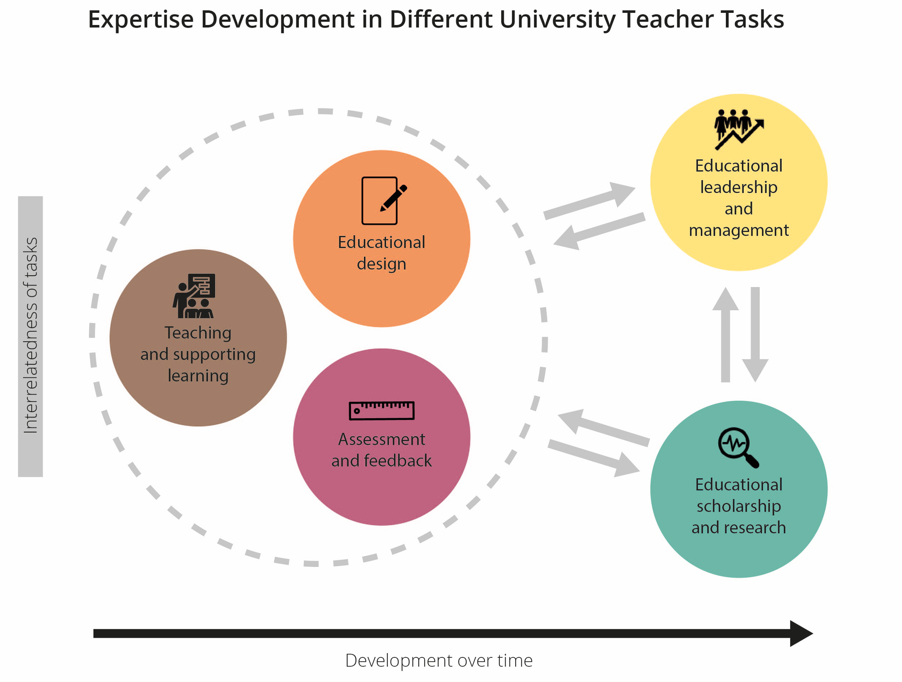 Visualisation of expertise development over time, and interrelatedness of different university teacher tasks, as experienced by academics in senior educational positions at Utrecht University. Based on Van Dijk E.E., van Tartwijk J., van der Schaaf M.F., Kluijtmans, M. (2024), ‘Academics’ expertise development in teacher tasks: A multiple case study’. International Journal for Academic Development.
From solo to team sport
Should every teacher now become an educational leader as well, or learn to conduct research on education? No; aiming at every academic being an expert on all fronts would be a massive dilution of our attention and manpower. It is crucial is to think and work in teams. Academics, as well as various types of experts and professionals from the field with different, unique specialties, can complement and reinforce one another. In each department, it seems desirable to have at least one or more academics with specific expertise in education. These ‘scholarly teachers’ or ‘teacher-scholars’ can contribute their knowledge of education to the team and generate new knowledge for the continuous development and optimisation of education in their respective fields.
Indeed, these education-specialized academics are the crucial link between policy, innovation, and implementation. They can constantly adapt the curriculum to provide students with the most up-to-date education of the highest quality.
Consider the example of a teacher who focuses on promoting inclusiveness of a course, researches this topic and develops interventions: this teacher may not only improve one’s own course, but may contribute to implementing policy in the wider institute, and may shares insights more widely through research publications and outreach. We will often see these advanced teachers being approached as experts, to help think about further policy development at their own institute or beyond, or as a speaker at a conference. This indicates a very strong interplay between policy, research, and education. When teachers contribute to knowledge about their own educational practice by generating context-specific insights and sharing them with colleagues, we refer to it as Scholarship of Teaching and Learning (SoTL). The goal of SoTL is to improve the teaching practice in one’s own course to enhance student learning. When the researcher’s aim is broader and focusses on theoretical knowledge that is also relevant outside one’s own teaching practice, we refer to it as ‘discipline-based education research’, or research of teaching in one’s own discipline.
Collaboration across faculties
A broad research university presents considerable untapped potential. It is precisely society’s current need for broad, interdisciplinary perspectives that can empower these broad research universities. The connection and synergy between research and education was at risk of being lost in recent decades but is now gaining renewed attention. There is a role here for primarily discipline-oriented programmes, where inter- and transdisciplinary elements add depth to one’s own discipline and stimulate the skills and attitudes needed for collaboration. But there is also room for broad interdisciplinary undergraduate or graduate programmes, such as liberal arts and sciences programmes, or courses centred around interdisciplinarity where students are specifically trained to integrate insights. Their unique place in the system is to train people for whom the broad perspective is always primary in their learning and thinking, but who also all go into such depth in one or more disciplines that they can develop a unique contribution to research or society. The presence of a wide range of disciplines at a university therefore presents enormous potential: we can reappraise a diverse palette of research approaches and perspectives, and students may actually come into contact with them in their education. However, this kind of potential does not emerge spontaneously; it requires changes in our organisation and culture.
The system
The number of university students has been increasing for decades, and this has resulted in certain systemic problems. How would we like that to develop in the ideal future? Higher education should remain sufficiently funded per student to retain quality and accessibility. It should also, importantly, be rooted in research, be it more applied or more academic.
Let’s start with accessibility: equitable access to higher education is a large concern. In the Netherlands, scholarships, once introduced to increase equity and accessibility, have been replaced by a loan system, resulting in high levels of debts for some students.[48] A limited form of a basic scholarship has been reintroduced recently, but higher education is still a substantial investment. These high costs can create barriers to participation in higher education. Moreover, the eventual study debts affect precisely those who are vulnerable, such as those who cannot easily repay these debts afterwards due to poor physical- or mental health. From the perspective of an open vision on education, we need to keep an ever-vigilant eye on accessibility and affordability.
When we say that higher education should be accessible, we do not intend to imply that everyone should pursue higher education. On the contrary. Basic or middle vocational education (in Dutch MBO) is often undervalued, while it is essential for training craftspeople who are urgently needed in society. The massive flow of students to higher education has to do with status and income expectations, whether real or not. So, the important thing is not to get everyone into higher education, but to get everyone into the right place. Higher education should be accessible to everyone with the necessary talent and ambition, independent of their socio-economic background.
The Netherlands is also a unique case, with the dual system of research universities and universities of applied sciences. Although both are higher education institutions, academic education is usually accorded more prestige than higher professional education. In the Netherlands, the term ‘university’ is mainly linked to academic education, while in English-speaking countries the term ‘university’ is used for both forms of education. In the Netherlands, we have observed a progressive shift from universities of applied sciences to enrolments at research universities. This, however, presents the risk of shortages in higher-educated people with a professional focus, while the academic nature of a university education risks being blurred due to emerging shortages of funding and the influx of students without the desired scientific curiosity or capacities. Students who would have been better suited for higher professional education, but who choose to enrol at a research university due to pressure from themselves, family, or peers. Extrinsic motivation, rather than intrinsic motivation. To properly educate the student of the future, we should address the differences in status within higher education and truly focus on the nature and content of study programmes. Only then can everyone fully develop their talents, and can we train both the academics and professionals that society needs.
Although universities have always engaged in exchanges, in the past it was mainly through individual mobility of staff and students. The globalised world and the complex problems we face oblige us to work as a collective knowledge system. Only then can we address the complex problems in a timely nature. COVID-19 powerfully demonstrated that if academics can cooperate globally, we can achieve insights and applications at an unprecedented speed. At the same time, the risk of virus emergence, the rise of anti-vaccination movements and differences in vaccination coverage and approaches to the pandemic showed that even a viral pandemic is perhaps more a socio-cultural problem than a biomedical one. All this calls for collaboration, not only between disciplines, as we outlined above, but also geopolitically. What does that mean for educating new generations and for our development curriculum for the current generation? We need to move away from individual programmes at individual higher education institutions and move towards providing education in networks and alliances. Besides the flexibility for the individual student, as we have described above, we also need to join forces organisationally and strategically, at an institutional and system level. These institutional collaborations obviously cannot function without (virtual) staff and student mobility, but they should become much more structural and hybrid than they are now. For example, think of courses and programmes offered in collaboration with several different institutions. Virtual international classrooms or virtual lecturing allows experts to contribute their expertise at several collaborating institutes. Social interaction is a crucial element in learning and knowledge creation, so this certainly does not mean everything should be online. But precisely by working with structural partnerships, we will be able to shift away from physical travel partly to online collaboration without losing the important sense of connection. Once you know each other, online collaboration becomes easier and more effective. So, we can consciously choose between travelling in person or collaborating online.
This means some major changes for the system as a whole. Within our institutes, we have to rethink our faculty organisation. Although the link with the individual discipline is and will remain of undiminished importance, the financial and organisational structure is now so strongly research- and faculty-oriented that it hinders cross-disciplinary and cross-faculty cooperation in education. Money flows could be linked to students instead of programmes, for example, which would make it easier to organise freedom of choice and exchange or cooperate in education across faculties.
Also, at larger scale, nationally, and certainly internationally, laws and regulations need to be adapted to facilitate inter-institutional collaboration in education.
Quality assurance, too, should start facilitating inter-faculty, inter-institutional and international programmes, as well as the Continuing Education offering. But that requires a complete redesign of the quality control system. Each country now has its own accreditation system. We need a way to recognise each other’s accreditation, and/or set up accreditation at the European level. A system of micro-credentialing could offer modular curricula the necessary quality control and status, which can help make Bachelor’s, Master’s and PhD programmes more flexible, and is especially crucial for Continuing Education offerings.
Within Europe, the ‘European University Initiative, a programme organised and funded by the European Commission, has resulted in a powerful movement to collaborate more intensively across the borders of institutions and countries. An example is provided in Inset 3.9, the CHARM-EU alliance. This is just one of 41 such alliances within the EU in 2022. European collaboration will have to intensify if we are to keep up with US and Asian universities in the long run. By acting together and strengthening each other, European universities can maintain their good reputation and high level of quality in the field of academic education for many years to come. This is not to say that we should not collaborate outside of Europe as well, but collaboration within Europe should be much more systematic, and outside-Europe more content-oriented.
Inset 3.9. CHARM-EU, a European University Alliance.
CHARM-EU is an initiative funded by the EU, through the Erasmus+ programme, with the aim of encouraging structural and strategic cooperation between European universities. Nine European institutions are currently part of CHARM-EU, including from the start Utrecht University. CHARM-EU is one of 64 European University alliances which in 2024 include in total 560 universities.[49]CHARM-EU represents a challenge-driven, accessible, research-based, and mobile model for the co-creation of a European university, in line with European values and the Sustainable Development Goals. In September 2021, CHARM-EU launched a Master’s programme: MSc in Global Challenges for Sustainability. As its name implies, the programme focuses on global sustainability challenges. The Master’s programme is unique in the world today. Students engage with sustainability issues in a transdisciplinary environment, based on concrete challenges faced by society.In addition to the Master’s programme, there is also a CHARM-EU transdisciplinary research initiative: TORCH (Transforming Open Responsible Research and Innovation through CHARM). TORCH aims to develop a common agenda for research and innovation.
Conclusion
One final reflection concerns the importance of public opinion and public support. There are some parallels with public engagement, as described in the chapter on Open Science. Public engagement refers to how the university interacts with a broad public, and contributes to public debate, impact, and support. This is vital for the willingness of social partners to cooperate in research and education, for basing public and political decisions on scientific knowledge, and also for the applicable legislation, regulations, and funding of our education. To use an example: we mentioned before: the concern about the lack of support for internationalisation of universities. From a university perspective, which is substantiated by research, we see internationalisation as crucial for the quality of research, education, and societal impact. If we, as universities, want to maintain and even expand our international intake of staff and students, we will have to make the need for it much clearer to politicians and the public. An integral part of our social mission is therefore to communicate what we do; why the university exists in the first place. We want to create added value in our interaction with society. Only by clearly demonstrating that added value we can actually realise our promise of research and education for society.
Biesta, G. J. J. (2020). Risking Ourselves in Education: Qualification, Socialization, and Subjectification Revisited. Educational Theory, 70(1), 89-104. doi.org/10.1111/edth.12411 ↑
This involves the integration of scientific and real-world insights to find solutions to complex real-world issues. ↑
Authors Inset: J. T. Jeuring & A. P. J. van den Bosch. ↑
Shulman, L. S. (1986). Those Who Understand: Knowledge Growth in Teaching. Educational Researcher, 15(2), 4-14. doi.org/10.3102/0013189X015002004 ↑
Shulman, L. S. (1986). Those Who Understand: Knowledge Growth in Teaching. Educational Researcher, 15(2), 4-14. doi.org/10.3102/0013189X015002004 ↑
Boyer, E. L. (1990). Scholarship Reconsidered: Priorities of the Professoriate. Carnegie Foundation for the Advancement of Teaching. ↑
Norman, G. (2011). Fifty Years of Medical Education Research: Waves of Migration. Medical Education, 45(8), 785-91. doi.org/10.1111/j.1365-2923.2010.03921.x ↑
Felten, P. (2013). Principles of Good Practice in SoTL. Teaching & Learning Inquiry: The ISSOTL Journal, 1(1), 121–125. doi.org/10.2979/teachlearninqu.1.1.121 ↑
Sociaal en Cultureel Planbureau. (2008). Rapport Vijftien jaar onderwijsvernieuwingen in Nederland. ↑
De Smet, P. J. (2023). Traditioneel versus Problem-Based Learning. Consulted on May 26, 2023, from: docplayer.nl/375255-Traditioneel-versus-problem-based-learning.html ↑
Van Dijk, E. E., Geertsema, J., Van der Schaaf M. J., Van Tartwijk J. & Kluijtmans, M. (2023). Connecting Academics’ Disciplinary Knowledge to their Professional Development as University Teachers: A Conceptual Analysis of Teacher Expertise and Teacher Knowledge. Higher Education, 86, 969-84. doi.org/10.1007/s10734-022-00953-2 ↑
Wallace, R. (2003). Online Learning in Higher Education: a review of research on interactions among teachers and students. Education, Communication & Information, 3(2), 241-80. doi.org/10.1080/14636310303143 ↑
Buena de la Fuente, G. (n.d.). What is Open Science? Introduction. FOSTER. fosteropenscience.eu/content/what-open-science-introduction ↑
Van Geelen, S. & Milota, M. (Eds.). (2022). De Nieuwe Utrechtse School: Historische Traditie en Hedendaagse Aanpak. Utrecht University. uu.nl/onderzoek/de-nieuwe-utrechtse-school ↑
Authors inset: S. M. van Geelen, B. J. M. Prakken, M. M. Milota, H. V. M. van Rijen. ↑
De Knecht, S., Van der Meer, M., Brinkman, L., Kluijtmans, M., Miedema, F. (2021). Reshaping the Academic Self: Connecting Education & Open Science. Zenodo. ↑
Choi, B. C. K. & Pak, A.W. P. (2006). Multidisciplinary, Interdisciplinarity and Transdisciplinarity in Health Research, Services, Education and Policy: 1. Definitions, Objectives, and Evidence of Effectiveness. Clinical and Investigative Medicine, 29(6), 351-64. ↑
McPhee, C., Bliemel, M. & Van der Bijl – Brouwer, M. (2018). Editorial: Transdisciplinary Innovation. Technology Innovation Management Review, 8(8), 3-6. ↑
Vereijken, M. W. C., Akkerman, S. F., Te Pas, S. F., Van der Tuin, I. & Kluijtmans, M. (2022). ‘Undisciplining’ Higher Education Without Losing Disciplines: Furthering Transformative Potential for Students. Higher Education Research & Development, 42(7), 1-14. doi.org/10.1080/07294360.2022.2156482 ↑
Akkerman, S. F. & Bakker, A. (2011). Boundary Crossing and Boundary Objects. Review of Educational Research, 81, 132-69. doi.org/10.26803/ijlter.16.10.6 ↑
Drost, R. H., Dictus, W. J. A. G., Prakken, B. J. & Bovenschen, N. (2019). How a Four-Year-Old Boy Connects Healthcare, Biomedical Research and Undergraduate Education. Nature Biotechnology, 37(9), 1092-5. doi.org/10.1038/s41587-019-0245-5 ↑
Christensen, G., Steinmetz, A., Alcorn, B., Bennett, A., Woods, D. & Emanuel, E. (2013). The MOOC Phenomenon: Who Takes Massive Open Online Courses and Why? SSRN. dx.doi.org/10.2139/ssrn.2350964 ↑
Mezirow, J. (1991). Transformative Dimensions of Adult Learning. Jossey-Bass. ↑
Ashwin, P. (2020). Transforming University Education: A Manifesto. Bloomsbury. ↑
Biesta, G. J. J. (2020). Risking Ourselves in Education: Qualification, Socialization, and Subjectification Revisited. Educational Theory, 70(1), 89-104. doi.org/10.1111/edth.12411 ↑
Young, M. & Muller, J. (2013). On the Powers of Powerful Knowledge. Review of Education, 1(3), 229-50. doi.org/10.1002/rev3.3017 ↑
Béneker, T. (2018). Krachtige Kennis in Geografieonderwijs [Inaugural lecture]. Utrecht University. Retrieved from: uu.nl ↑
Schunk, D. (2020). Learning Theories an Educational Perspective. Pearson. ↑
Vygotsky, L. S. (1978). Mind in Society: The Development of Higher Psychological Processes. Harvard University Press. ↑
Biggs, J. & Tang, C. (2011). Teaching for Quality Learning at University. Open University Press. ↑
Schellekens, L. H., Bok, H. G. J., De Jong, L. H., Van der Schaaf, M. F., Kremer, W. D. J. & Van der Vleuten, C. P. M. (2021). A Scoping Review on the Notions of Assessment as Learning (AaL), Assessment for Learning (AfL), and Assessment of Learning (AoL). Studies in Educational Evaluation, 71. doi.org/10.1016/j.stueduc.2021.101094 ↑
Reimann, N., Sadler, I. & Sambell, K. (2019). What’s in a Word? Practices Associated with ‘Feedforward’ in Higher Education. Assessment & Evaluation in Higher Education, 44(8), 1279-90. doi.org/10.1080/02602938.2019.1600655 ↑
Boud, D. (2000). Sustainable Assessment: Rethinking Assessment for the Learning Society. Studies in Continuing Education, 22(2), 151-67. doi.org/10.1080/713695728 ↑
Schuwirth, L. W. T. & Van der Vleuten, C. P. M. (2011). Programmatic Assessment: From Assessment of Learning to Assessment for Learning. Medical Teacher, 33(6), 478-85. doi.org/10.3109/0142159X.2011.565828 ↑
Heeneman, S., De Jong, L. H., Dawson, L. J., Wilkinson, T. J., Ryan, A., Tait, G. R., Rice, N., Torre, D., Freeman, A. & Van der Vleuten, C. P. M. (2020). Ottawa 2020 Consensus Statement for Programmatic Assessment – 1. Agreement on the Principles. Medical Teacher, 43(10), 1139-48. doi.org/10.1080/0142159X.2021.1957088 ↑
Bok, H. G. J., Teunissen, P. W., Favier, R. P., Rietbroek, N. J., Theyse, L. F. H., Brommer, H., Haarhuis, J. C. M., Van Breukelen, P., Van der Vleuten, C. P. M. & Jaarsma, D. A. D. C. (2013). Programmatic Assessment of Competency-Based Workplace Learning: When Theory Meets Practice. BMC Medical Education, 13(123). doi.org/10.1186/1472-6920-13-123 ↑
Schut, S., Maggio, L. A., Heeneman, S., Van Tartwijk, J., Van der Vleuten, C. & Driessen E. (2021). Where the Rubber Meets the Road – An Integrative Review of Programmatic Assessment in Health Care Professions Education. Perspectives on Medical Education, 10(1), 6-13. doi.org/10.1007/s40037-020-00625-w ↑
Bok, H. G. J., Teunissen, P. W., Favier, R. P., Rietbroek, N. J., Theyse, L. F. H., Brommer, H., Haarhuis, J. C. M., Van Breukelen, P., Van der Vleuten, C. P. M. & Jaarsma, D. A. D. C. (2013). Programmatic Assessment of Competency-Based Workplace Learning: When Theory Meets Practice. BMC Medical Education, 13(123). doi.org/10.1186/1472-6920-13-123 ↑
Hermans, H. J. M. & Hermans-Konopka, A. (2010). Dialogical Self Theory: Positioning And Counter-Positioning in A Globalizing Society. Cambridge University Press. ↑
Mylopoulos, M. (2020). Preparing Future Adaptive Experts: Why it Matters and How it Can be Done. Medical Science Educator, 30, 11-2. doi.org/10.1111/medu.12426 ↑
Hatano, G. & Inagaki, K. (1984). Two Courses of Expertise. Research and Clinical Center for Child Development Annual Report, 6, 27-36. ↑
Akkerman, S. F. & Bakker, A. (2011). Boundary Crossing and Boundary Objects. Review of Educational Research, 81, 132-69. doi.org/10.26803/ijlter.16.10.6 ↑
Lave, J. & Wenger, E. (1991). Situated Learning: Legitimate Peripheral Participation. Cambridge University Press. ↑
Kolb, D. (1984). Experiential Learning as the Science of Learning and Development. Prentice Hall. ↑
Karstens, B., Kool, L., Lemmens, A., Doesborgh, S. & Montanus, R. (2022). Naar Hoogwaardig Digitaal Onderwijs. Rathenau Instituut. ↑
Van Tricht, M. (2019). Hoe data de kwaliteit van het onderwijs kunnen verbeteren. SURF. surf.nl ↑
Siemens, G. (2013). Learning Analytics: The Emergence of a Discipline. American Behavioral Scientist, 57(10), 1380-400. doi.org/10.1177/0002764213498851 ↑
Comijs, D. & Karg, P. (2018). De Opkomst en Ondergang van de Basisbeurs een Geschiedenis. Redpers. Retrieved from: redpers.nl ↑
https://education.ec.europa.eu/education-levels/higher-education/european-universities-initiative ↑